


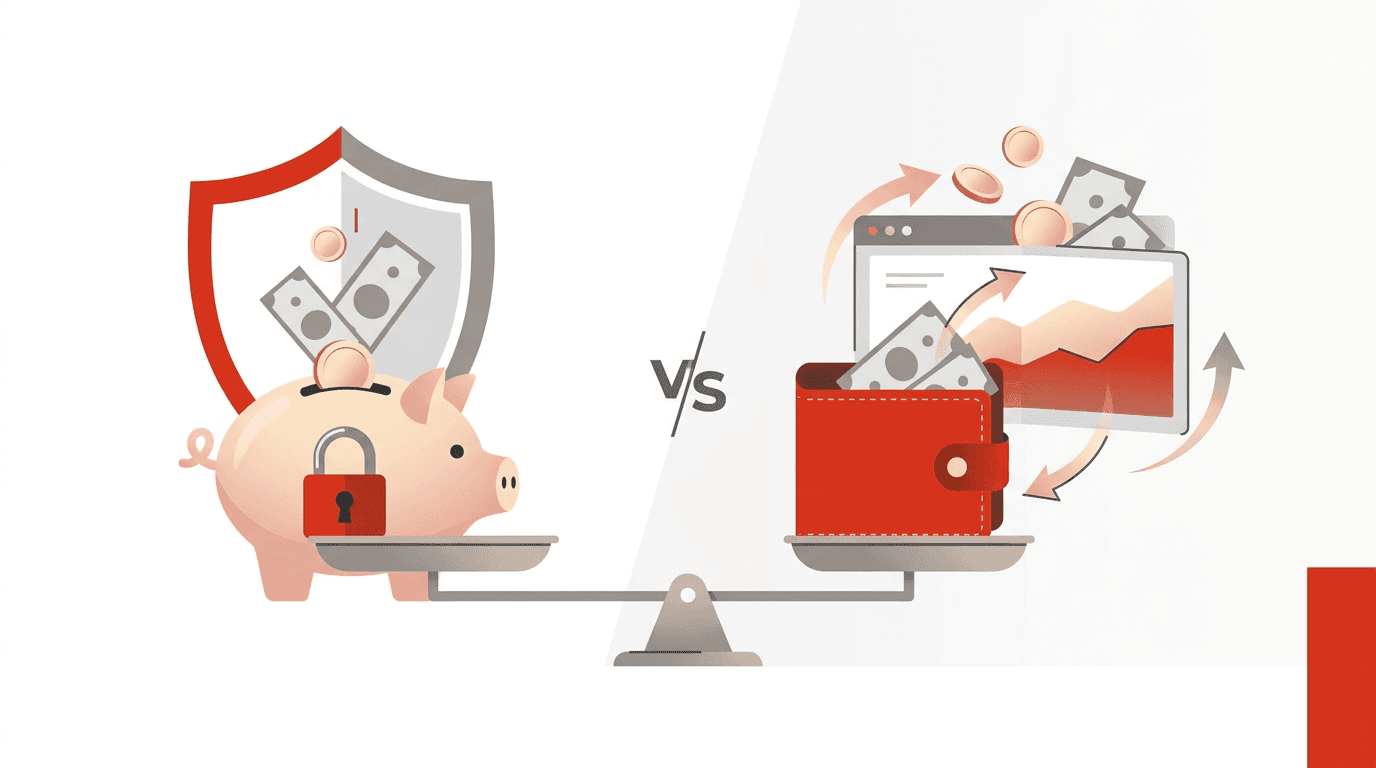
Most explanations of pillar 3a vs 3b are written by insurance companies trying to sell you a 3b policy. Here's the honest version: for the vast majority of people in Switzerland, pillar 3a is the only one that matters. Pillar 3b is just a fancy label for "everything else you save." Understanding the difference takes five minutes and could save you from buying a product you don't need.
What Is the Difference Between Pillar 3a and 3b?
Switzerland's private pension system (the "third pillar") splits into two parts: pillar 3a (tied/bound provision) and pillar 3b (free provision). They serve different purposes and come with very different rules.
Pillar 3a is the tax-advantaged retirement savings account. You get a direct tax deduction on every franc you contribute, but the money is locked until retirement (with a few exceptions). It's regulated by federal law (BVV 3) and has strict contribution limits.
Pillar 3b is essentially everything else you save or invest privately. Savings accounts, stocks, real estate, life insurance policies, art collections. There's no contribution limit and no lock-in period, but also no annual tax deduction on contributions. The term "pillar 3b" is often used by insurance companies to market life insurance products, but legally it encompasses all private wealth accumulation.
The key insight: pillar 3a gives you a guaranteed tax return on your money. Pillar 3b does not. That's why 3a should almost always come first. The Swiss government's official page on the third pillar provides a basic overview, but we'll go much deeper here.
Pillar 3a vs 3b: The Complete Comparison
Here's everything you need to know at a glance:
| Feature | Pillar 3a (Tied) | Pillar 3b (Free) |
|---|---|---|
| Tax deduction on contributions | Yes, 100% deductible | No (with rare cantonal exceptions) |
| Contribution limit (2026) | CHF 7,258 (with pension fund) / CHF 36,288 (without) | No limit |
| Withdrawal | At retirement (5 years before/after) | Anytime |
| Early withdrawal exceptions | Home purchase, emigration, self-employment, disability | No restrictions |
| Tax on capital at withdrawal | Reduced rate, taxed separately | Generally tax-free (if held as bank savings or securities) |
| Tax on returns during accumulation | Tax-free (no income/wealth tax) | Subject to income and wealth tax |
| Beneficiary rules | Fixed legal order | Free choice |
| Who can contribute | Anyone with AHV-liable earned income | Anyone |
| Providers | Banks and insurance companies | Banks, insurers, brokers, self-directed |
| Regulated by | BVV 3 (federal ordinance) | No specific regulation |
How Do Taxes Work for 3a vs 3b?
This is where the real difference lies, and it's significant.
Pillar 3a: Triple tax advantage
Pillar 3a offers what's sometimes called a "triple tax benefit":
- Contributions are tax-deductible. Every franc you put in reduces your taxable income. At a marginal tax rate of 30%, contributing CHF 7,258 saves you roughly CHF 2,177 in taxes. That's an immediate, guaranteed return.
- No tax during accumulation. While your money sits in a 3a account, you pay no income tax on interest or dividends, and no wealth tax on the balance. In a regular account, you'd pay both.
- Reduced tax at withdrawal. When you take the money out at retirement, it's taxed at a special reduced rate, separate from your regular income. Depending on your canton and the amount, the effective rate is typically 5% to 10%.
Pillar 3b: No contribution deduction, but different exit rules
With pillar 3b, there's no tax deduction when you contribute. Your savings come from after-tax income, and returns are taxed normally (interest as income, securities subject to wealth tax).
The one area where 3b has an advantage: capital gains on securities are tax-free in Switzerland for private investors. If you invest in stocks through a regular brokerage account (which counts as 3b), your price gains aren't taxed. Only dividends are.
For insurance-based 3b products (life insurance policies), the tax treatment can be favorable if certain conditions are met: the policy must run for at least 10 years, and the payout must happen after age 60. In that case, the capital payout can be tax-free. But the fees on these products often eat up any tax benefit.
Contribution Limits: 3a Is Capped, 3b Is Not
One of the biggest practical differences:
Pillar 3a (2026 limits):
- With a pension fund (most employees): CHF 7,258 per year
- Without a pension fund (some self-employed): up to CHF 36,288 per year (20% of net earned income)
These limits are set by the Federal Council and adjusted every few years based on the BVG maximum insured salary.
Pillar 3b: No limit whatsoever. You can save and invest as much as you want. That's the main appeal for high earners who've already maxed out their 3a.
New in 2026: if you missed 3a contributions in previous years (starting from 2025), you can now make retroactive backpayments. This is a major change. Read our guide to 3a contribution limits for the details.
When Can You Withdraw the Money?
This is where 3b clearly wins on flexibility.
Pillar 3a
Your 3a money is locked until you reach retirement age (currently 65 for men, 64 for women). You can withdraw it up to 5 years before retirement age.
Early withdrawal is only allowed for:
- Buying your primary residence (or paying down the mortgage)
- Leaving Switzerland permanently
- Starting self-employment
- Full disability (IV pension)
- The 3a balance is below a de minimis threshold
When you withdraw, you must take the entire balance of each 3a account. You can't do partial withdrawals. That's why it makes sense to split your 3a savings across multiple accounts (3 to 5 is typical) and withdraw them in different tax years.
Pillar 3b
Your 3b money is yours to access whenever you want. No restrictions, no conditions, no waiting period. This is the fundamental advantage.
Need the money for a career change? Available. Want to buy a car? Available. Emergency fund? Available.
The trade-off is clear: total flexibility, but no tax deduction on the way in.
Your 3a money is locked until you reach retirement age (currently 65 for men, 64 for women). You can withdraw it up to 5 years before retirement age.
Early withdrawal is only allowed for:
- Buying your primary residence (or paying down the mortgage)
- Leaving Switzerland permanently
- Starting self-employment
- Full disability (IV pension)
- The 3a balance is below a de minimis threshold
When you withdraw, you must take the entire balance of each 3a account. You can't do partial withdrawals. That's why it makes sense to split your 3a savings across multiple accounts (3 to 5 is typical) and withdraw them in different tax years.
Your 3b money is yours to access whenever you want. No restrictions, no conditions, no waiting period. This is the fundamental advantage.
Need the money for a career change? Available. Want to buy a car? Available. Emergency fund? Available.
The trade-off is clear: total flexibility, but no tax deduction on the way in.
Who Should Use Pillar 3a vs 3b?
Here's the practical framework:
Always max out pillar 3a first. If you have AHV-liable earned income and you haven't contributed the maximum CHF 7,258 for the year, do that before putting money anywhere else. The tax deduction alone gives you an immediate 20% to 35% return depending on your canton. No other legal savings vehicle in Switzerland comes close.
Consider pillar 3b (regular saving/investing) after 3a is maxed. Once you've contributed the full CHF 7,258, your next best option is usually a low-cost investment portfolio in a regular brokerage account. This technically counts as "pillar 3b," even though most people don't think of it that way.
Be very cautious with 3b insurance products. Life insurance policies marketed as "pillar 3b solutions" are rarely the best choice. They combine savings and insurance in a single product, which sounds convenient but typically results in higher fees and lower returns than keeping the two separate.
Max out 3a with a low-cost investment solution. Only start 3b savings after 3a is full. At this stage, flexibility matters less than tax savings.
Max out 3a (CHF 7,258), then invest additional savings in a regular portfolio. Skip insurance-based 3b products. Use the tax-free capital gains on securities instead.
If you don't have a pension fund, your 3a limit is CHF 36,288. That's already a massive tax deduction. Most self-employed people don't need 3b at all.
Can You Convert Pillar 3a to 3b (or Vice Versa)?
No. You cannot convert a 3a account into a 3b account, or transfer money between them. They are completely separate legal frameworks. Once money is in a 3a account, it follows 3a rules (locked until retirement). Once money is in a 3b vehicle, it follows whatever rules apply to that vehicle (savings account, brokerage, insurance policy).
The only "conversion" that happens is at withdrawal: when you take money out of a 3a account, it becomes regular assets (effectively 3b) after you've paid the withdrawal tax.
Is Pillar 3b Tax-Deductible?
Generally, no. Contributions to pillar 3b cannot be deducted from your taxable income at the federal level. However, a few cantons (notably Geneva and Fribourg) allow limited deductions for certain 3b insurance products. The amounts are small (CHF 2,000 to CHF 4,000 per year depending on your situation) and only apply to qualifying life insurance policies.
If you're in Geneva or Fribourg and considering a 3b insurance product, check the cantonal tax rules. For everyone else, the answer is straightforward: 3b is not tax-deductible.
What About the Beneficiary Rules?
This is an often-overlooked difference that matters for estate planning.
Pillar 3a has a legally fixed beneficiary order. If you die, the capital goes to:
- Your surviving spouse or registered partner
- Your direct descendants (children)
- Your parents
- Your siblings
- Other heirs
You can adjust the ranking within certain groups, but you can't skip a group entirely. You can't leave your 3a to a friend or an unrelated person.
Pillar 3b gives you full freedom. You decide who gets the money. This is relevant for people in non-traditional family structures, unmarried partners, or anyone who wants to leave money to specific individuals or organizations.
For a deeper dive into how to choose between a bank and an insurance company for your 3a, read our bank vs insurance guide.
After years of optimizing my own finances, my advice is simple: max out pillar 3a every year, preferably with a low-cost investment solution like VIAC or Finpension. That's your single biggest financial win in Switzerland. Once 3a is maxed, invest additional savings in a regular brokerage account. Skip the 3b life insurance products. They're designed to make money for insurance companies, not for you. The only exception is if you're in Geneva or Fribourg and the cantonal tax deduction genuinely makes the math work. But for 95% of people, a simple 3a + brokerage account is the optimal setup.

Common Mistakes with Pillar 3a and 3b
Insurance agents love to sell 3b policies to people who haven't even opened a 3a account. The 3a tax deduction is worth CHF 1,500 to CHF 2,500 per year. No 3b product comes close to that guaranteed return. Always fill up 3a first.
Pillar 3b isn't a product you "open." It's a legal category that covers all private savings outside of 3a. Your regular savings account is 3b. Your stock portfolio is 3b. Your apartment is 3b. When someone tries to sell you a "3b solution," they usually mean an insurance policy with high fees.
Since you must withdraw an entire 3a account at once, having all your money in one account means a bigger tax hit at retirement. Split across 3 to 5 accounts and withdraw in different tax years to reduce the progressive tax rate on each withdrawal.
Starting in 2026, you can retroactively contribute for years you missed (from 2025 onward). If you've been in Switzerland for years without maxing out 3a, check whether you're eligible for backpayments. It's essentially free tax savings.
Frequently Asked Questions
What is the difference between pillar 3a and 3b in Switzerland?
Pillar 3a is the tied (bound) private pension. Contributions are tax-deductible up to CHF 7,258 per year (2026), but the money is locked until retirement. Pillar 3b is the free (unbound) private provision, covering all other private savings and investments. There's no contribution limit and no lock-in, but also no tax deduction on contributions.
Is pillar 3b tax-deductible in Switzerland?
No, pillar 3b contributions generally cannot be deducted from taxable income at the federal level. A few cantons (Geneva, Fribourg) allow limited deductions for qualifying life insurance products, typically CHF 2,000 to CHF 4,000 per year. For most Swiss residents, 3b offers no tax deduction.
Should I invest in pillar 3a or 3b first?
Always max out pillar 3a first. The tax deduction gives you an immediate 20% to 35% return on your contribution, depending on your canton. Only after you've contributed the full CHF 7,258 should you consider additional savings through pillar 3b (regular investments). No 3b product matches the guaranteed return of the 3a tax deduction.
Can I convert pillar 3a to pillar 3b?
No. You cannot transfer or convert money between pillar 3a and 3b. They are entirely separate legal frameworks. Once money is in a 3a account, it follows 3a withdrawal rules. The only way money moves from 3a to 3b is when you make a qualifying withdrawal at retirement and the proceeds become regular assets.
What happens to my pillar 3a and 3b if I leave Switzerland?
If you leave Switzerland permanently, you can withdraw your entire pillar 3a balance. It will be taxed at the reduced withdrawal rate. Your pillar 3b assets (savings, investments, property) are yours to take with you, subject to normal tax rules. If you move to an EU/EFTA country, mandatory pension fund capital (2nd pillar) may have restrictions, but pillar 3a can be fully withdrawn.