


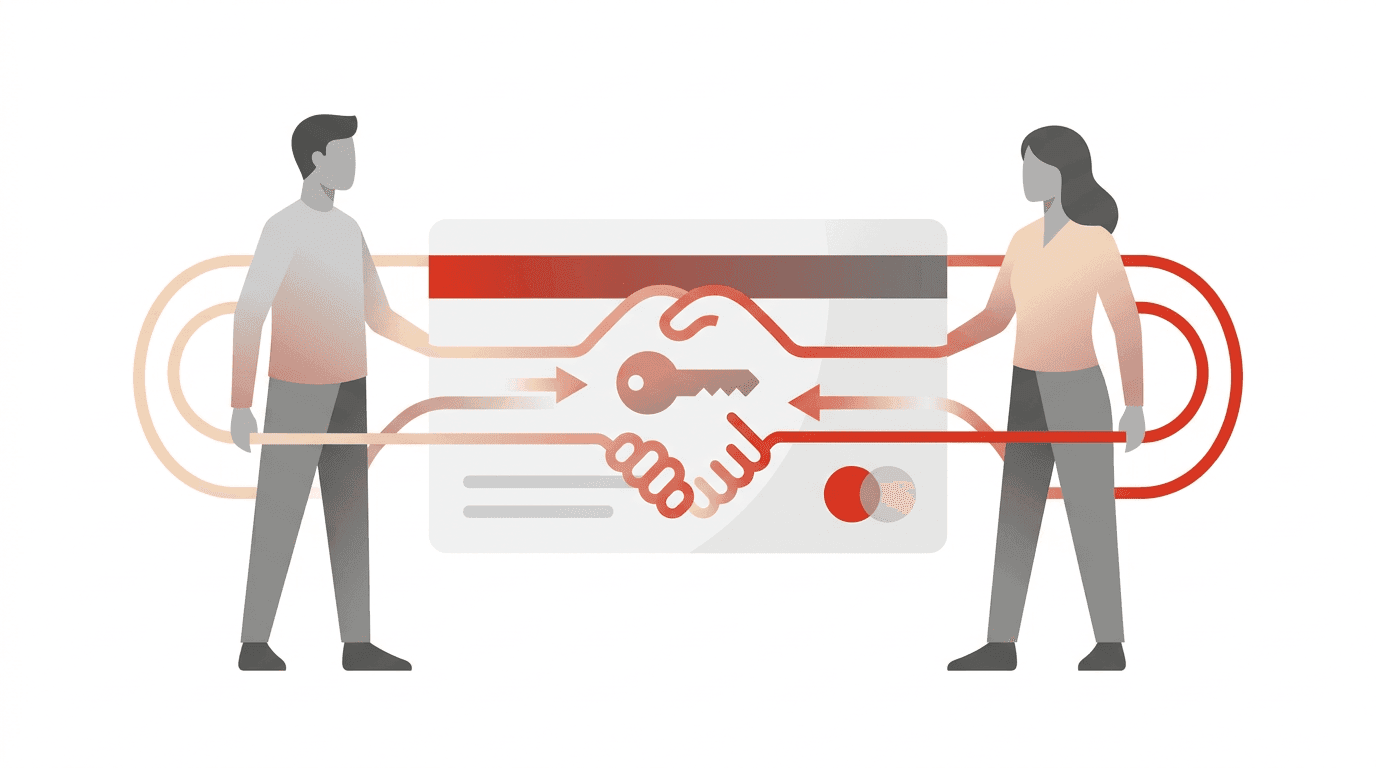
Most Swiss couples manage their shared expenses by sending TWINT requests back and forth like ping-pong. There's a better way, and it takes about 10 minutes to set up.
What Is a Joint Account in Switzerland?
A joint account is a bank account shared by two or more people. Each account holder gets their own debit card and full access to the account balance. You both deposit money, you both spend from it. Simple.
In Switzerland, joint accounts are mainly used by couples (married or not), registered partners, and flatmates to pay shared expenses like rent, groceries, insurance, and utilities. Instead of tracking who paid what and settling up every month, everything runs through one account.
Here's what most people don't realize: Swiss banks don't usually market "joint accounts" as a separate product. It's the same private account you'd open for yourself, but with two or more holders listed on it. Some neobanks like Neon have created dedicated joint products (Neon Duo), but traditional banks simply add a second holder to an existing account.
The cost of running a joint account in Switzerland ranges from CHF 0 to CHF 25 per month, depending on the bank. Digital-first options like Bank WIR and ZKB charge nothing. Neon Duo runs CHF 6 per month. UBS charges CHF 15-25 monthly for their couples package. The spread is huge, which is exactly why comparing matters.
"Or" Account vs "And" Account: Which Type Do You Need?
This is the one thing nobody explains clearly. Swiss banks offer two types of joint accounts, and picking the wrong one will make your life miserable.
Or Account (Oder-Konto)
Each account holder can act independently. You can make transfers, withdraw cash, and pay bills without needing permission from the other holder. This is the standard for household accounts and what you almost certainly want.
Best for: Couples paying everyday bills, flatmates splitting rent, anyone who values convenience.
And Account (Und-Konto)
Every transaction requires consent from all account holders. Both people must approve before any money moves. This sounds secure, but it's extremely impractical for daily use.
Best for: Business partnerships, inheritance situations, or when legal protection matters more than convenience.
Each account holder can act independently. You can make transfers, withdraw cash, and pay bills without needing permission from the other holder. This is the standard for household accounts and what you almost certainly want.
Best for: Couples paying everyday bills, flatmates splitting rent, anyone who values convenience.
Every transaction requires consent from all account holders. Both people must approve before any money moves. This sounds secure, but it's extremely impractical for daily use.
Best for: Business partnerships, inheritance situations, or when legal protection matters more than convenience.
Bottom line: Go with an "Or" account for household expenses. Nearly every Swiss bank defaults to this model. If you find yourself needing an "And" account, you're probably dealing with a legal situation where you should consult a lawyer anyway.
Which Swiss Banks Offer Joint Accounts?
Not every bank makes this easy. Traditional banks generally offer joint accounts as part of their standard private account lineup, while neobanks are more selective.
Digital banks
Neon Duo is the dedicated joint account product from Neon. CHF 3 per person per month gets you a shared account with two debit cards, full mobile app access, and integration with Wise for international transfers. Both account holders must live at the same address.
Bank WIR (Bankpaket Top) offers a genuinely free joint account, including free debit cards and zero foreign currency surcharges. The catch: you need to meet one of their eligibility conditions (CHF 200 share certificate, mortgage, pension fund, or CHF 1,500 monthly deposit).
Zak from Bank Cler doesn't offer a true joint account. Their "shared pots" feature lets two people track joint expenses through linked personal accounts, but legally each person owns their own account. It's a workaround, not the real thing.
Traditional banks
ZKB (Zurich Cantonal Bank) offers a free joint account with two debit cards included through their ZKB Banking package. Excellent if you live in the Zurich area and value branch access. Only available in German and English.
PostFinance Smart provides a joint account for CHF 5 per month with access to Switzerland's largest ATM network (4,000+ locations). Practical if you use cash regularly.
UBS offers joint accounts through their UBS me package for couples at CHF 15-25 monthly. Expensive, but includes credit cards and premium services. Makes sense only if you already bank with UBS.
Migros Bank gives you a free private account with a second debit card for CHF 30 per year. Straightforward and affordable if you shop at Migros anyway.
Cantonal banks generally offer joint accounts with varying fee structures. The best deals are at Aargauische Kantonalbank (free, debit cards included) and ZKB. Most others charge CHF 3-6 monthly plus CHF 30-50 annually per debit card.
How Much Does a Joint Account Cost?
Here's a realistic cost breakdown for the most popular options. These are the total annual costs for two people, including account fees and debit cards.

CHF 0/year total. Free account, free debit cards, free foreign currency transactions. Requires eligibility condition.

CHF 0/year total. Free account with 2 debit cards. Additional cards CHF 40/year each. Branch access in Zurich.
CHF 72/year total (CHF 6/month). Plus CHF 10 one-time per card. Best mobile experience with Wise integration.
Hidden costs to watch for:
- Second debit card fees: CHF 30-50 per year at many banks
- Foreign ATM withdrawals: CHF 5-10 per transaction
- Paper statements: CHF 3-5 monthly (go digital)
- Account closure: CHF 0-50 when you close the account
- Foreign currency transactions: 0-2.5% markup depending on the bank
The cheapest overall option is Bank WIR's Bankpaket Top at CHF 0 per year, followed by ZKB at CHF 0. Neon Duo at CHF 72 per year is pricier but delivers the best pure digital experience. UBS at CHF 180-300 per year only makes sense if you need their full banking ecosystem.
How to Open a Joint Account in Switzerland
Compare accounts based on fees, debit card costs, mobile banking quality, and whether you need branch access. Use our bank account comparison to see all options side by side.
Both account holders need: valid ID (Swiss ID or passport), proof of Swiss address, and residence permit (for non-Swiss nationals). Some banks require proof of shared residence for specific products like Neon Duo.
For digital banks, both people complete video identification through the app. Takes 10-15 minutes each. For traditional banks, either apply online together or visit a branch. Both holders must identify themselves.
Create standing orders from each person's salary account to the joint account. Decide upfront how much each person contributes, whether that's 50/50 or proportional to income.
Debit cards typically arrive within 3-7 business days. Set up mobile payments (Apple Pay, Google Pay) for both holders. Start directing shared expenses to the new account.
The entire process takes 10-15 minutes for digital banks and 1-2 weeks for traditional banks. No appointment needed with most online options.
How Do Joint Accounts Affect Your Taxes?
This is where people get confused, and honestly, it's simpler than you think.
Each person declares their share. If two people split the account equally, each declares 50% of the account balance as wealth and 50% of any interest earned as income on their tax return.
For unmarried couples or flatmates, the split follows what you actually contribute. If you put in 60% and your partner puts in 40%, declare accordingly. The tax office in your canton may ask for proof if the split isn't 50/50.
For married couples, joint accounts are declared together on your shared tax return anyway, so it doesn't matter which spouse's name is listed first.
Interest income from joint accounts is taxable. Swiss banks automatically deduct 35% withholding tax (Verrechnungssteuer) on interest. You reclaim this when filing your tax return, as long as you declare the account.
Do You Actually Need a Joint Account?
Honestly? Not everyone does. Here's a quick decision framework.
A joint account makes sense if:
- You share a household and have regular shared expenses (rent, groceries, utilities)
- You're tired of tracking who owes what and sending TWINT requests constantly
- You want both partners to have equal access and visibility over shared spending
- You trust the other person completely (because they'll have full access)
You might not need one if:
- You're good at splitting bills with TWINT or Splitwise
- You prefer keeping finances entirely separate
- One person already handles all shared expenses and the other reimburses monthly
- You're in a temporary living situation (short-term flatshare)
For couples who've been together for a while and share expenses anyway, a joint account almost always simplifies life. For flatmates, it depends on how many shared expenses you actually have. If it's just rent and internet, a simple monthly transfer might be easier than opening a whole new account.
How Many People Can Share a Joint Account?
Most Swiss banks allow two holders by default. Many will add more on request, and some have no limit at all.
Two holders standard: Bank Cler, Migros Bank, LLB, Neon (strictly two), Hypothekarbank Lenzburg.
Unlimited holders: ZKB, Berner Kantonalbank, Luzerner Kantonalbank, Valiant, Thurgauer Kantonalbank.
Flexible: Aargauische Kantonalbank allows two online and unlimited in-branch. Raiffeisen recommends a maximum of five.
For flatshares with more than two people, ZKB and Raiffeisen are your best options since they support multiple holders without fuss. Neon Duo is strictly limited to two people at the same address.
Common Mistakes with Joint Accounts
Before opening the account, decide exactly how much each person deposits monthly. Whether it's 50/50 or proportional to income, put it in writing. Vague arrangements create resentment fast, especially when one person earns significantly more than the other.
The joint account is for shared expenses only. Personal purchases should go through your individual accounts. Mixing the two defeats the purpose and creates bookkeeping chaos. Set clear ground rules about what counts as "shared."
Both holders are jointly liable for the account. If the account goes into overdraft, both of you owe the bank. If one person drains the account and disappears, the other person is still responsible. Only open a joint account with someone you genuinely trust.
When the relationship ends, close the joint account immediately. Split the balance, redirect any standing orders, and formally notify the bank. Until the account is closed, both holders retain full access. People have lost significant money by not acting quickly enough.
Keep only what you need for 1-2 months of shared expenses. Anything beyond that should go into a savings account where it earns interest. A joint checking account paying 0% interest is no place to park emergency funds, especially since deposit protection only covers CHF 100,000 per joint account.
My Recommendation
After researching every joint account option in Switzerland, here's my honest take: most couples should start with Bank WIR or ZKB if they want free banking, or Neon Duo if they prioritize the best mobile experience.
From personal experience managing shared finances, the biggest win isn't picking the cheapest account. It's actually sitting down with your partner and agreeing on a system: how much each person contributes, what counts as shared expenses, and what stays personal. The account is just a tool. The conversation is what matters.
If you're just starting out as a couple, Neon Duo at CHF 6/month is the easiest entry point. Great app, Wise integration for travel, and the dedicated joint account experience is genuinely well designed. If you're optimizing for zero fees and don't mind Bank WIR's eligibility conditions, that's the frugal champion.
Check our best bank accounts comparison to see how these options fit into the broader Swiss banking landscape, or our guide on how to open a bank account if you need step-by-step help with the process.

Frequently Asked Questions
How do I open a joint account in Switzerland?
Both account holders need valid ID and a Swiss address. With digital banks like Neon or Bank WIR, you can open one online in about 10-15 minutes each via video identification. Traditional banks require either an online application or a branch visit. Both holders must identify themselves before the account is activated.
What is the best joint account in Switzerland?
Bank WIR's Bankpaket Top is the cheapest at CHF 0 per year with free debit cards and no foreign currency surcharges. ZKB Banking is the best free traditional bank option. Neon Duo offers the best mobile experience at CHF 72 per year. The right choice depends on whether you prioritize cost, convenience, or branch access.
Can unmarried couples open a joint account in Switzerland?
Yes. Most Swiss banks don't require you to be married, in a civil partnership, or even living together. The exception is Neon Duo, which requires both holders to share the same address. At traditional banks, you simply need to establish a plausible relationship between the account holders.
What happens to a joint account if we break up?
Both holders retain full access until the account is formally closed. Either holder can withdraw the entire balance from an "Or" account. Contact the bank immediately, agree on splitting the balance, redirect standing orders, and close the account. Act fast to avoid disputes.
How are joint accounts taxed in Switzerland?
Each holder declares their share of the balance as wealth and their share of interest as income on their tax return. For equal contributions, that's 50/50. For unequal splits, declare proportionally to what you contribute. Married couples file jointly, so it's included in your shared return automatically.