

If you're new to Swiss banking, the first thing you'll notice is that nobody talks about "checking accounts." In Switzerland, your everyday account is called a Privatkonto (private account), and it works differently from what you might expect. The real question isn't which one to pick. It's understanding that you probably need both.
What is the difference between a savings and current account in Switzerland?
A current account (Privatkonto) handles your daily financial life. Salary comes in, rent goes out, groceries get paid. It comes with a debit card, mobile banking, and full payment functionality. Think of it as your financial command center.
A savings account (Sparkonto) exists for one purpose: storing money you don't need right now. It pays higher interest than a current account, but comes with withdrawal restrictions. You can't pay bills from it or attach a debit card to it.
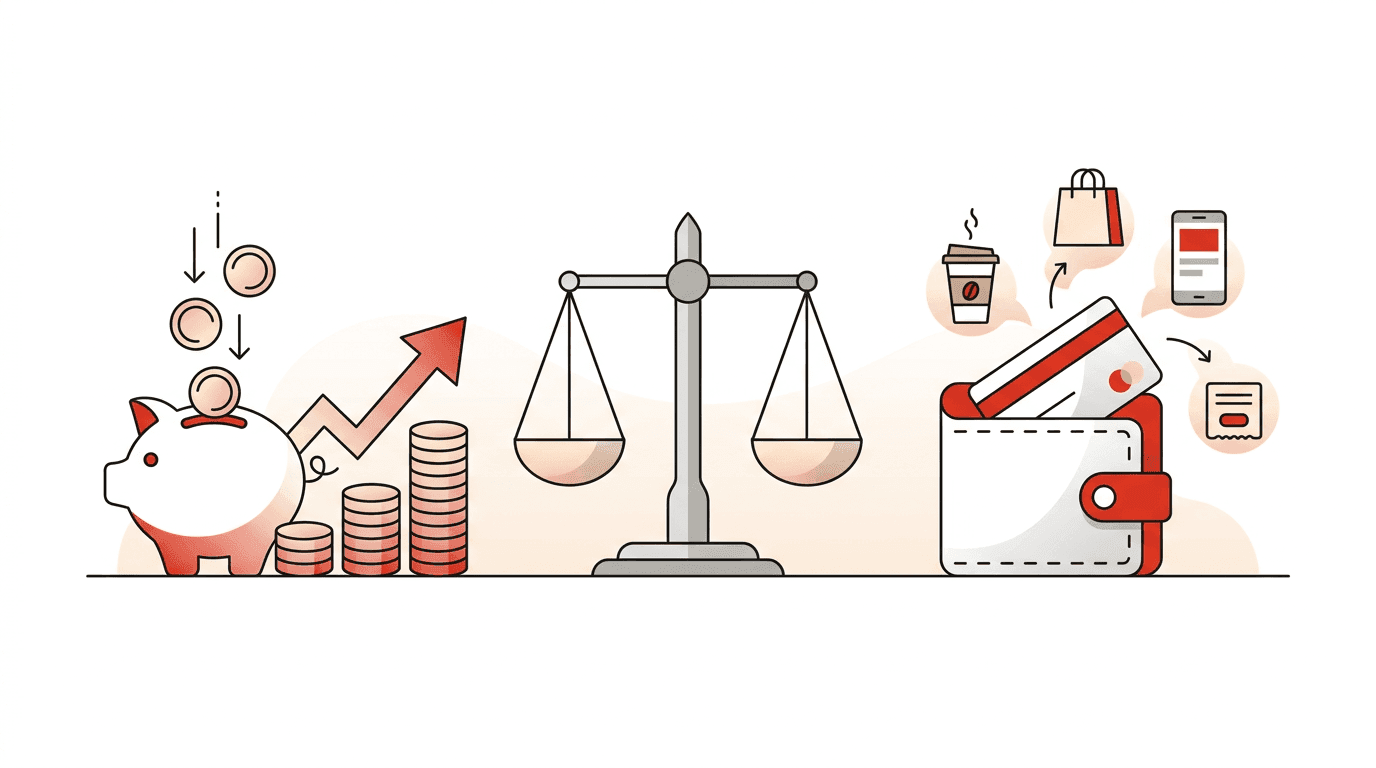
The core trade-off is simple: current accounts give you flexibility with near-zero interest. Savings accounts give you better interest with limited access. In Switzerland, the gap between the two is significant. Top current accounts pay 0% to 0.05% interest. Top savings accounts pay 0.3% to 1.0% (see our current savings interest rates for the latest figures).
On CHF 50,000, that's the difference between earning CHF 25 and earning CHF 500 per year. Same deposit protection, same Switzerland. The only difference is how easily you can access the money.
How Swiss account types work
Swiss banking uses different terminology than most countries. Here's what you'll actually encounter:
Privatkonto (Private Account / Current Account) is your everyday transactional account. This is where your employer deposits your salary, where your standing orders for rent and insurance come from, and what your debit card is linked to. Every bank in Switzerland offers one. Fees range from CHF 0 to CHF 15 per month.
Sparkonto (Savings Account) is designed purely for saving. Higher interest rates, but limited withdrawals. Most savings accounts cap withdrawals at CHF 10,000 to CHF 50,000 per year, and some require 3 to 6 months' notice before you can take money out. Penalties apply if you exceed the limits.
Lohnkonto (Salary Account) is sometimes used interchangeably with Privatkonto, but at some banks it's a distinct product. It receives your salary and may come with slightly different conditions.
Jugendkonto / Studentenkonto are special accounts for young people (under 25 or 30), often with better conditions than standard accounts.
The key thing newcomers miss: in Switzerland, your savings account and current account are always separate. You can't just "switch" money between them like transferring between checking and savings at an American bank. They're distinct products, often with different account numbers, and transfers between them may take a day.
Savings vs current account: key differences at a glance
Current Account (Privatkonto)
Purpose: Everyday transactions, salary, bills, payments
Interest rate: 0% to 0.05% (effectively nothing)
Fees: CHF 0 to CHF 15/month (top-rated accounts are free)
Access: Unlimited withdrawals, debit card, mobile payments, TWINT
Best accounts: Zak by Bank Cler (CHF 0, ranked #1), Bank WIR (CHF 0), Yuh (CHF 0)
Best for: Salary, rent, daily spending, paying bills
Savings Account (Sparkonto)
Purpose: Storing and growing money you don't need immediately
Interest rate: 0.1% to 1.0% (10x to 100x more than current accounts)
Fees: CHF 0 at all top-rated savings accounts
Access: Limited withdrawals (CHF 10,000 to CHF 50,000/year), notice periods (0 to 6 months)
Best accounts: CEA Compte Epargne Plus (1.0%), Bank WIR Savings Plus (0.75%), Crédit Agricole (0.4%)
Best for: Emergency fund, medium-term savings, money you won't touch for months
Purpose: Everyday transactions, salary, bills, payments
Interest rate: 0% to 0.05% (effectively nothing)
Fees: CHF 0 to CHF 15/month (top-rated accounts are free)
Access: Unlimited withdrawals, debit card, mobile payments, TWINT
Best accounts: Zak by Bank Cler (CHF 0, ranked #1), Bank WIR (CHF 0), Yuh (CHF 0)
Best for: Salary, rent, daily spending, paying bills
Purpose: Storing and growing money you don't need immediately
Interest rate: 0.1% to 1.0% (10x to 100x more than current accounts)
Fees: CHF 0 at all top-rated savings accounts
Access: Limited withdrawals (CHF 10,000 to CHF 50,000/year), notice periods (0 to 6 months)
Best accounts: CEA Compte Epargne Plus (1.0%), Bank WIR Savings Plus (0.75%), Crédit Agricole (0.4%)
Best for: Emergency fund, medium-term savings, money you won't touch for months
Should I use a savings or current account in Switzerland?
Short answer: you need both. This isn't a question of either/or. Almost every Swiss resident has at least one of each, and for good reason.
Your current account handles the flow of money through your life. Without one, you can't receive a salary, pay rent, or use a debit card. It's non-negotiable for living in Switzerland.
Your savings account is where you build your financial buffer. The interest rate difference is real money. On CHF 30,000, a savings account at 0.75% earns CHF 225 per year. A current account at 0.05% earns CHF 15. That's CHF 210 you're leaving on the table for no reason.
The smart approach:
- Keep 1 to 2 months of expenses in your current account (enough to cover salary timing gaps and upcoming bills)
- Move everything else to a savings account (3 to 6 months of expenses for your emergency fund)
- Anything beyond that should go into Pillar 3a or investments
This is exactly what Swiss financial advisors recommend, and it's what I do personally. Your current account is a transit station, not a parking lot.
How much does the interest rate difference actually matter?
Let's be honest: Swiss interest rates aren't going to make anyone rich. But the gap between current and savings accounts is larger than most people realize.
- Current account at 0.05% (Zak): CHF 25
- Savings account at 0.75% (Bank WIR): CHF 375
- Savings account at 1.0% (CEA): CHF 500
- Gap: CHF 350 to CHF 475 per year
Over 10 years with compounding, the difference on CHF 50,000 between a current account (0.05%) and a savings account (0.75%) is roughly CHF 3,500. Not life-changing, but it's free money for doing nothing more than opening a second account.
Where this really matters: people who park CHF 100,000+ in a current account "for convenience." At 0% interest, that money is losing value to inflation every single day. A savings account won't fully protect against inflation either, but it cuts the loss significantly.
Which banks offer the best combination?
Some banks make it easy to hold both account types under one roof. Here's what works well:
Bank Cler (Zak) offers the #1 ranked private account (CHF 0 fees, 0.05% interest) plus a solid Savings Account Plus (0.1% base + bonus interest on new money). The app handles both seamlessly. If you want simplicity, this is it.
Bank WIR provides a free private account (ranked #3) and the second-best savings account (0.75% until September 2026). Different products, but available nationwide.
Cantonal banks (ZKB, BCV, BEKB) typically offer both a free private account and a savings account. Interest rates on savings are modest (0.1% to 0.2%), but the cantonal guarantee protects deposits beyond the standard CHF 100,000.
The mix-and-match approach: Use Zak for daily banking (free, great app) and Bank WIR for savings (0.75% interest). Different banks, but the extra 10 minutes to set up a second relationship pays for itself many times over. Check our best private accounts and best savings accounts rankings for the full comparison.
Expert recommendation
After building GetRates and analyzing 76 bank accounts across Switzerland, here's my honest take on the savings vs. current account question: most people keep way too much money in their current account.
I see it constantly. Someone has CHF 40,000 sitting in a Privatkonto earning 0%. They could move CHF 30,000 to a savings account at 0.75% and earn CHF 225 per year for exactly zero effort. That's a nice dinner out, every year, for free.
My setup: I use a free digital account (Zak) for daily banking with about one month of expenses, and I park my emergency fund at Bank WIR's savings account at 0.75%. For anything beyond 6 months of expenses, I invest through Pillar 3a and ETFs, because even 1% interest won't beat inflation long-term.
If you're new to Switzerland, start with a free private account, then open a savings account within your first month. It takes 15 minutes and it's the easiest financial optimization you'll ever make.

Common mistakes when choosing Swiss bank accounts
The biggest and most common mistake. If you have more than 2 months of expenses in your Privatkonto, you're losing money to both inflation and opportunity cost. Move the excess to a savings account where it earns 10x to 100x more interest.
There's no rule saying your savings and current accounts must be at the same bank. The best current account (Zak) and the best savings account (CEA or Bank WIR) are at different banks. Mix and match for the best combination.
The highest-rate savings accounts have the strictest limits. CEA's 1% caps withdrawals at CHF 10,000 per year. If you might need the money, choose an account with limits that match your actual needs, even if the rate is slightly lower.
Unlike some countries where savings and checking are linked, Swiss savings and current accounts are distinct. Transfers between them may take a business day. Plan ahead for large expenses instead of assuming instant access.
Frequently asked questions
What is the difference between a savings account and a current account in Switzerland?
A current account (Privatkonto) is for daily transactions: salary, bills, debit card payments. A savings account (Sparkonto) is for storing money with better interest rates but limited withdrawals. Current accounts pay 0% to 0.05% interest. Savings accounts pay 0.1% to 1.0%. Most Swiss residents use both.
Should I use a savings or current account in Switzerland?
You need both. A current account is required for daily banking. A savings account earns significantly more interest on money you don't need immediately. Keep 1 to 2 months of expenses in your current account and move the rest to savings. This is the standard recommendation from Swiss financial advisors.
How much money should I keep in my Swiss savings account?
3 to 6 months of living expenses as an emergency fund. On average, that's CHF 15,000 to CHF 30,000 for a single person in Switzerland. Money beyond your emergency fund should go into Pillar 3a (up to CHF 7,258 per year) or investments for better long-term returns.
Can I use a savings account for daily payments in Switzerland?
No. Swiss savings accounts don't support debit cards, direct debits, or payment transactions. They're designed purely for saving. You need a current account (Privatkonto) for daily payments, salary deposits, and bill payments. You can transfer money between the two, but transfers may take a business day.
Is it worth having both a savings and current account at the same bank?
Convenience yes, but not always the best rates. Having both at one bank makes transfers instant and simplifies your banking. But the best current account (Zak) and the best savings account (CEA or Bank WIR) are at different banks. If maximizing interest matters, use separate banks. If simplicity matters more, Bank Cler offers a good combination of both.
What to do next
If you're setting up your Swiss banking, start with a free private account for daily use, then add a savings account for your emergency fund and excess cash. The whole process takes 30 minutes across two apps, and the interest difference pays for itself from day one.