

Most Swiss consumers carry both a debit card and a credit card, yet surprisingly few understand when to reach for which one. The difference goes way beyond "one debits now, the other debits later." In Switzerland specifically, the rules around acceptance, fees, and consumer protection create real situations where picking the wrong card costs you money.
What's the Actual Difference Between Debit and Credit Cards?
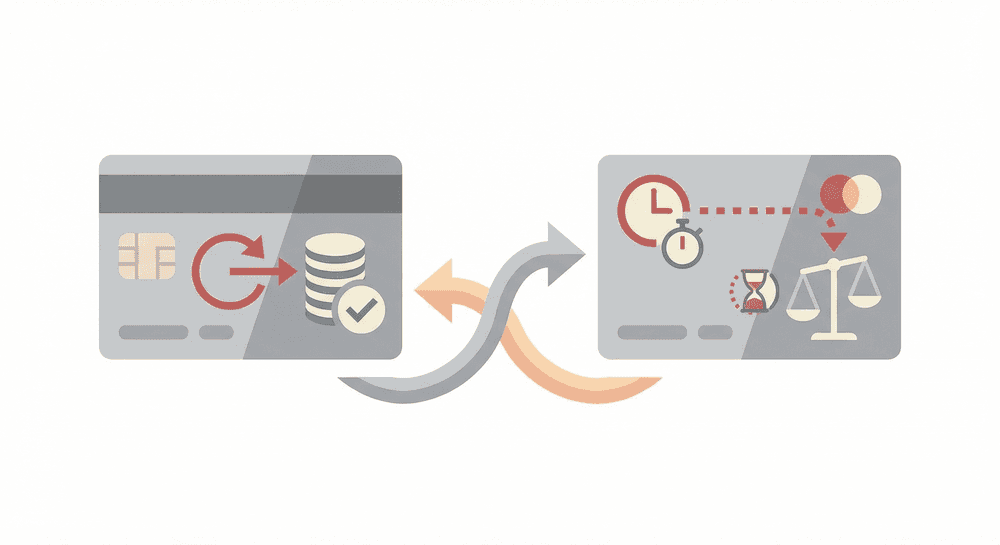
A debit card pulls money directly from your bank account the moment you pay. A credit card lets you spend up to a set limit, then bills you once a month. That's the textbook answer, and it's technically correct. But in practice, the distinction matters most in three areas: who carries the risk, when you pay, and what protections you get.
With a debit card, the money leaves your account instantly. If someone skims your card or a fraudulent charge goes through, your actual cash is gone until the bank investigates and (hopefully) refunds it. With a credit card, the charge hits the issuer's money first. You dispute it before it ever touches your bank balance.
The "pay later" part of credit cards isn't about encouraging debt in Switzerland. Most Swiss credit card holders pay their full balance every month via direct debit (LSV/eBill). The real advantage is the 30-day float, which gives you time to verify charges and dispute problems before money leaves your account. That buffer matters more than most people realize.
Do You Need a Credit Card in Switzerland in 2026?
Honestly? You can get through 95% of daily life with just a debit card and TWINT. Grocery shopping at Coop and Migros, filling up your car, eating out, paying for parking. Your Visa Debit or Debit Mastercard handles all of that without issues.
But here's where that remaining 5% catches you off guard. Car rentals almost universally require a credit card for the deposit. Hotels frequently need one for the reservation guarantee. Some international online services (certain streaming platforms, airline bookings, travel insurance purchases) still reject debit cards. And if you travel outside Switzerland regularly, a credit card with decent foreign currency fees saves you real money.
The honest answer: no, you don't strictly need a credit card for everyday Swiss life. But the moment you rent a car, book a hotel, or travel abroad, not having one becomes a genuine headache. Given that several Swiss credit cards cost CHF 0 per year, there's almost no reason not to have one as a backup.
Where Debit Cards Win in Switzerland
Debit cards have genuine advantages that credit cards can't match. Here's where they're the better choice.
Cash withdrawals are dramatically cheaper. Pulling cash from your own bank's ATMs with a debit card is free. Doing the same with a credit card typically costs CHF 10 or more per withdrawal, plus interest from day one. This isn't a close contest.
Spending control is built in. You can only spend what you have. No credit limit temptation, no surprise bill at the end of the month. For people building financial discipline or managing a tight budget, this matters enormously.
Lower annual fees. Most Swiss bank packages include a debit card for CHF 0 to CHF 50 per year. Credit cards range from CHF 0 (basic free cards) to CHF 1,000+ (luxury cards). If you're cost-conscious, a debit card as your primary payment tool keeps expenses minimal.
TWINT integration. Nearly all Swiss debit cards connect seamlessly to TWINT, which has become the dominant mobile payment method in Switzerland. While credit cards also work with TWINT, the debit card connection is typically more straightforward.
Where Credit Cards Win in Switzerland
Credit cards aren't just about borrowing money. They offer practical benefits that debit cards simply can't replicate.
Consumer protection and chargebacks. This is the single biggest advantage. If a merchant doesn't deliver what they promised, charges you incorrectly, or goes bankrupt after you've paid, you can dispute the charge with your credit card issuer. With a debit card, your money is already gone. Getting it back requires your bank to intervene, and the process is slower and less certain.
Travel insurance and perks. Many Swiss credit cards include travel medical insurance (coverage up to CHF 1,000,000+), trip cancellation protection, rental car insurance, and purchase protection. Buying these separately would cost CHF 100 to CHF 300+ per year. If your card includes them, the annual fee suddenly looks reasonable.
Wider international acceptance. While Visa Debit and Debit Mastercard work at most international merchants, credit cards still have an edge in certain situations. Automated fuel pumps abroad, some toll systems, cruise ship payments, and various online merchants still prefer or require credit cards.
Rewards. Debit cards in Switzerland offer virtually no rewards. Credit cards can earn you 0.25% to 1% cashback or equivalent points on every purchase. On CHF 20,000 of annual spending, that's CHF 50 to CHF 200 back. Not life-changing, but it's free money if you'd spend that amount anyway. Compare options in our best credit cards guide.
Debit vs Credit Card Fees: What You Actually Pay
Here's where things get real. Forget the marketing, look at the numbers.
Debit Card Costs
- Annual fee: CHF 0 to CHF 50 (usually included in your bank package)
- Cash withdrawal (own bank ATM): Free
- Cash withdrawal (other Swiss ATM): CHF 0 to CHF 2 per transaction
- Cash withdrawal abroad: CHF 5 + 0.25% to 0.50% of the amount
- Foreign currency purchases: 1.0% to 1.75% (varies by bank)
- Swiss purchases in CHF: Free
The big catch: foreign currency fees on debit cards can be surprisingly high at traditional banks. Neobanks like Neon or Yuh often offer much better rates.
Credit Card Costs
- Annual fee: CHF 0 to CHF 1,000+ (wide range depending on tier)
- Cash withdrawal (Switzerland): CHF 10+ per transaction, plus interest from day one
- Cash withdrawal abroad: CHF 10+ per transaction, plus interest and FX fee
- Foreign currency purchases: 1.2% to 2.5% (issuer-dependent, check our fees guide)
- Swiss purchases in CHF: Free (some cards give cashback)
- Late payment interest: 9% to 15% annually on unpaid balances
The big catch: never use a credit card for cash withdrawals. The fees and immediate interest make it absurdly expensive.
- Annual fee: CHF 0 to CHF 50 (usually included in your bank package)
- Cash withdrawal (own bank ATM): Free
- Cash withdrawal (other Swiss ATM): CHF 0 to CHF 2 per transaction
- Cash withdrawal abroad: CHF 5 + 0.25% to 0.50% of the amount
- Foreign currency purchases: 1.0% to 1.75% (varies by bank)
- Swiss purchases in CHF: Free
The big catch: foreign currency fees on debit cards can be surprisingly high at traditional banks. Neobanks like Neon or Yuh often offer much better rates.
- Annual fee: CHF 0 to CHF 1,000+ (wide range depending on tier)
- Cash withdrawal (Switzerland): CHF 10+ per transaction, plus interest from day one
- Cash withdrawal abroad: CHF 10+ per transaction, plus interest and FX fee
- Foreign currency purchases: 1.2% to 2.5% (issuer-dependent, check our fees guide)
- Swiss purchases in CHF: Free (some cards give cashback)
- Late payment interest: 9% to 15% annually on unpaid balances
The big catch: never use a credit card for cash withdrawals. The fees and immediate interest make it absurdly expensive.
Bottom line on fees: For Swiss domestic spending, both card types cost roughly the same (zero for purchases). Debit cards win massively on cash withdrawals. Credit cards can win on foreign spending if you choose a card with low FX fees. And credit cards with rewards can actually pay you back on purchases.
Visa Debit and Debit Mastercard: The New Swiss Standard
If you're wondering about the "new" debit cards that replaced Maestro and V-Pay, here's the deal.
Since 2023, Swiss banks have been phasing out Maestro cards and replacing them with Visa Debit or Debit Mastercard. These new cards look almost identical to credit cards (they carry the Visa or Mastercard logo) and work for online shopping, which Maestro cards couldn't do.
This has blurred the line between debit and credit cards significantly. Your Visa Debit card now works at nearly every online store, supports Apple Pay and Google Pay, and is accepted internationally almost everywhere a credit card would be.
So why would you still need a credit card? Three reasons remain:
- Car rental deposits and hotel guarantees still frequently require actual credit cards
- Consumer protection (chargeback rights) is stronger on credit cards
- Rewards and insurance perks only come with credit cards
The new debit cards solved the online shopping and mobile payment gaps. But they didn't solve the protection and perks gaps. Those remain credit card territory.
When to Use Your Debit Card vs Credit Card
Use your debit card. No fees on either card type, but debit keeps your spending visible in real-time on your bank account. Less mental accounting needed.
Either works fine. If the store is reputable (Digitec, Galaxus, Zalando CH), debit is perfectly safe. For unfamiliar stores or marketplace sellers, credit offers better dispute protection.
Use your credit card (ideally one with low foreign currency fees). Better fraud protection, chargeback rights if something goes wrong, and potentially lower FX markups depending on your card.
Credit card as primary, debit card as backup. The credit card handles hotels, car rentals, and larger purchases with better protection. Keep your debit card for ATM withdrawals (much cheaper than credit card cash advances).
Always use your debit card. Credit card cash withdrawals in Switzerland cost CHF 10+ and charge interest immediately. Debit card withdrawals from your bank's ATMs cost nothing.
Common Mistakes With Debit and Credit Cards
This is the most expensive mistake you can make. Credit card cash advances cost CHF 10+ per transaction and charge interest from day one (no grace period). On a CHF 500 withdrawal, you might pay CHF 15 in fees plus daily interest. Always use your debit card for cash.
The new Visa Debit and Debit Mastercard look like credit cards, but they're not. Car rental companies, some hotels, and certain online services specifically require a credit card. Check the word "Debit" or "Credit" on your card before assuming it'll work everywhere.
If your debit card is Visa Debit, get your credit card on Mastercard (or vice versa). If one network has issues or your card gets frozen, you have a fallback. This costs nothing if you choose a free credit card.
Traditional Swiss banks often charge 1.5% or more on foreign currency transactions with debit cards. That's comparable to (or worse than) many credit cards. Check your bank's fee schedule before traveling. You might find your credit card is actually cheaper abroad.
Swiss credit cards charge 9% to 15% annual interest on unpaid balances. Set up automatic full payment via LSV or eBill. The entire credit card model only works in your favor if you pay the full balance every month. No exceptions.
My Recommendation: Debit or Credit Card in Switzerland?
After years of optimizing my own finances and analyzing every Swiss card product, here's my honest setup: I use both, and so should you. My debit card handles 80% of my spending: groceries, restaurants, everyday stuff. It keeps my budget real-time and transparent. My credit card covers travel, online purchases from international stores, and anything where I want chargeback protection.
The key insight most articles miss: the "best" choice depends on the specific transaction, not on picking one card type for everything. A free debit card plus a free credit card costs you CHF 0 per year and covers every scenario. That's the setup I'd recommend for most Swiss residents. Only upgrade to a paid credit card if you genuinely use the travel insurance and rewards. Compare your options in our best credit cards guide and check the eligibility requirements before applying.

Frequently Asked Questions
What is the difference between a debit card and credit card in Switzerland?
A debit card deducts money directly from your bank account when you pay. A credit card charges purchases to a credit line, and you receive a monthly bill. In Switzerland, both Visa Debit and credit cards work at most merchants, but credit cards offer stronger consumer protection (chargeback rights) and are required for car rentals and hotel deposits. Debit cards are better for ATM withdrawals and daily budget control.
Do you need a credit card in Switzerland?
Not for daily life. A Visa Debit or Debit Mastercard covers groceries, restaurants, online shopping, and most payments. However, you'll need a credit card for car rentals, some hotel reservations, and certain international services. Since several Swiss credit cards have no annual fee, there's little reason not to have one as a backup.
Is it safer to use a debit or credit card for online shopping?
Credit cards are generally safer for online shopping. If a merchant doesn't deliver or charges you incorrectly, you can dispute the charge with your credit card issuer (chargeback). With a debit card, the money leaves your account immediately and recovering it is harder. For trusted Swiss retailers, debit cards are fine. For international or unfamiliar stores, use a credit card.
Are Visa Debit cards the same as Visa credit cards?
No. Despite carrying the same Visa logo and working at most of the same merchants, Visa Debit cards deduct money immediately from your bank account, while Visa credit cards bill you monthly. Visa Debit cards lack the chargeback protections, rewards, and insurance perks that come with Visa credit cards. Car rental companies and some hotels specifically require credit cards and will reject Visa Debit.
Which card should I use when traveling abroad from Switzerland?
Use your credit card as your primary payment method abroad for purchases, hotels, and car rentals. It offers better fraud protection and chargeback rights. Use your debit card for ATM cash withdrawals, which are much cheaper than credit card cash advances. Always carry both on different networks (one Visa, one Mastercard) for maximum coverage. Check our fees guide to compare foreign currency charges.