


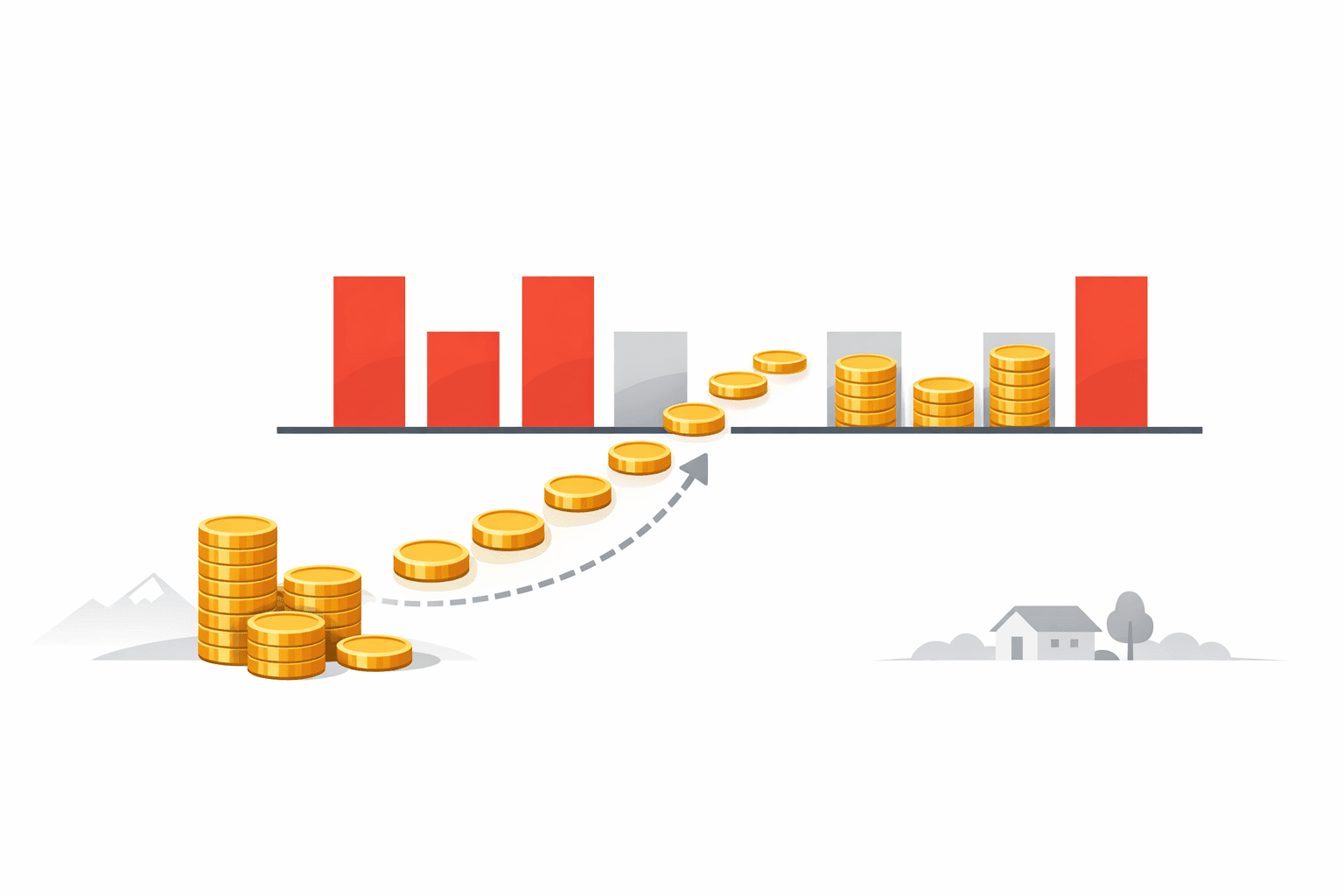
Switzerland just gave you a second chance at retirement savings. Starting in 2026, you can retroactively fill contribution gaps in your pillar 3a for up to 10 years back. If you missed payments in 2025 or later, you can now catch up and deduct those backpayments from your taxes. Here's exactly how it works, who qualifies, and what you need to watch out for.
What Is a Pillar 3a Backpayment?
A pillar 3a backpayment (also called a retroactive contribution or "Nachzahlung" in German) lets you make up for years when you didn't pay the full maximum into your pillar 3a. Before this regulation, if you missed a year or only paid part of the maximum, that tax-advantaged space was lost forever.
The Swiss Federal Council changed this at the end of 2024. The new regulation took effect on January 1, 2025, and the first actual backpayments became possible starting January 1, 2026.
The key rule: You can only backpay for contribution gaps that occurred from 2025 onwards. If you missed payments in 2024 or earlier, those gaps are permanently closed. The regulation is forward-looking only.
This matters because pillar 3a institutions only started systematically tracking contribution gaps from 2025. There's no reliable data on earlier gaps, so the law doesn't try to cover them.
Who Can Make Retroactive Pillar 3a Contributions?
Not everyone qualifies. You need to meet all of these conditions simultaneously:
You must have earned AHV-liable income in both years. That means income subject to Swiss social security contributions, both in the year when the gap occurred and in the year you want to make the backpayment. If you took a career break, went on parental leave, or were studying full-time without AHV-liable income in the gap year, you can't backpay for that year.
You must have maxed out your current year's regular contribution first. Before you can make any backpayment, you need to have paid the full maximum ordinary contribution for the current year. For 2026, that's CHF 7,258 if you're employed with a pension fund. Only after that's done can you add the backpayment on top.
You must not have started withdrawing any pillar 3a funds. Once you begin taking retirement benefits from any of your 3a accounts (earliest at age 60), you lose the right to make backpayments entirely. This applies even if you still have other 3a accounts open.
How Much Can You Backpay Per Year?
The maximum backpayment per year is the "small contribution" amount, which is CHF 7,258 for 2026. This limit applies regardless of whether you're employed with a pension fund or self-employed without one.
Here's how the math works in practice:
Regular maximum contribution (2026): CHF 7,258 (with pension fund) or CHF 36,288 (without pension fund, capped at 20% of net income)
Maximum backpayment (2026): CHF 7,258 (always the small amount, even for self-employed)
Maximum total deduction in one year: CHF 7,258 regular + CHF 7,258 backpayment = CHF 14,516
That's significant. You're essentially doubling your tax-deductible pillar 3a contribution in any year where you make a backpayment. Depending on your canton and tax bracket, that could mean CHF 2,000 to CHF 4,500 in additional tax savings.
You can close gaps from multiple past years in a single year, as long as each gap year's backpayment stays within the limit. However, each gap year can only be "closed" once with a single payment. You can't spread a single year's gap across multiple payments in different years.
The 10-Year Window: Timeline and Deadlines
The backpayment window works on a rolling 10-year basis. You have up to 10 years to close a contribution gap after it occurs.
You contribute less than CHF 7,258 to your pillar 3a. The difference between what you paid and the maximum becomes your "contribution gap." If you paid CHF 5,000, your gap is CHF 2,258.
This is the earliest you can make a retroactive payment for 2025. You must first pay the full CHF 7,258 for 2026, then you can add up to CHF 2,258 as a backpayment for 2025.
You have until the end of 2035 to close the 2025 gap. After that, the gap is permanently closed.
Practical example: Suppose you contributed CHF 2,000 in 2025, leaving a gap of CHF 5,258. In 2026, after paying the full CHF 7,258 for the current year, you could backpay the entire CHF 5,258 for 2025 in one payment. Or you could wait and do it in 2030, as long as you've maxed out 2030's regular contribution first.
What Tax Savings Can You Expect?
Both your regular pillar 3a contribution and any backpayment are fully deductible from your taxable income. The actual tax savings depend on your marginal tax rate, which varies by canton and income level.
For someone earning CHF 100,000 in Zurich, the marginal tax rate (federal + cantonal + municipal) is roughly 30-35%. That means:
- Regular contribution only (CHF 7,258): approximately CHF 2,200 to CHF 2,540 in tax savings
- Regular + full backpayment (CHF 14,516): approximately CHF 4,400 to CHF 5,080 in tax savings
- Additional savings from backpayment alone: CHF 2,200 to CHF 2,540
Over 10 years of backpayments, that's potentially CHF 22,000 to CHF 25,000 in additional tax savings. Plus, your capital grows tax-free inside the pillar 3a until withdrawal.
For a more precise calculation based on your canton and income, use our pillar 3a calculator which factors in cantonal tax rates.
Common Misconceptions About Pillar 3a Backpayments
Let's clear up the most frequent misunderstandings.
The regulation only covers gaps from January 1, 2025 onwards. If you didn't contribute between 2010 and 2024, those years are gone. The system only tracks gaps from 2025 forward because institutions weren't recording this data before.
You need AHV-liable income in the gap year to qualify for a backpayment. If you took a career break for parenting, education, or a sabbatical without earning AHV-liable income, that year doesn't produce a closable gap. The gap only exists when you could have contributed but chose not to (or contributed less than the maximum).
Each gap year gets one shot. If you backpay CHF 3,000 for the 2025 gap this year, you can't come back next year and pay another CHF 2,258 for the same gap. The gap is considered "addressed" after the first backpayment, even if you didn't fill it completely. Plan your backpayment amount carefully.
You can only make a backpayment if you've already paid the full maximum for the current year. If you only contribute CHF 5,000 for 2026, you can't add a backpayment on top. The current year must be fully covered first.
Once you withdraw from any 3a account (from age 60), all backpayment rights are lost across all your accounts. If you're planning staggered withdrawals and backpayments simultaneously, you need to finish all backpayments before making your first withdrawal.
How to Make a Backpayment: Practical Steps
The process is straightforward, but you need to follow it correctly.
Contact your pillar 3a provider (bank, insurance company, or digital provider like Finpension, VIAC, or Frankly) and submit a written request for a retroactive purchase. Your provider will verify your eligibility based on their records.
Ensure your regular contribution is paid first. Transfer the full CHF 7,258 for the current year before (or at the same time as) making the backpayment. Some providers handle both in one transaction; others require two separate transfers.
Make the backpayment as a single lump sum. The backpayment for a specific gap year must be done in one payment within a single calendar year.
Declare it in your tax return. The backpayment is tax-deductible separately from your regular contribution. Your 3a provider will issue a certificate showing both the regular contribution and the backpayment amount.
Backpayment vs. Pension Fund Buy-In: Which Is Better?
If you have extra cash for retirement savings, you might wonder whether to prioritize pillar 3a backpayments or second-pillar (pension fund) buy-ins. Both are tax-deductible, but they work differently.
Pillar 3a backpayment
Advantages: You control the provider and investment strategy. Lower fees with modern providers. Full flexibility on timing within the 10-year window. Capital is yours to withdraw under specific conditions.
Limitation: Maximum CHF 7,258 per year, regardless of income or gap size. Always the "small contribution" ceiling.
Pension fund buy-in
Advantages: Buy-in amounts can be much larger (tens of thousands of CHF), depending on your pension fund gap. Bigger immediate tax deduction. Some funds offer guaranteed interest.
Limitation: Money is locked in the pension fund with less provider choice. Fees are often higher. Withdrawal options are more restrictive.
Advantages: You control the provider and investment strategy. Lower fees with modern providers. Full flexibility on timing within the 10-year window. Capital is yours to withdraw under specific conditions.
Limitation: Maximum CHF 7,258 per year, regardless of income or gap size. Always the "small contribution" ceiling.
Advantages: Buy-in amounts can be much larger (tens of thousands of CHF), depending on your pension fund gap. Bigger immediate tax deduction. Some funds offer guaranteed interest.
Limitation: Money is locked in the pension fund with less provider choice. Fees are often higher. Withdrawal options are more restrictive.
My recommendation: If you have both options available, max out the pillar 3a backpayment first (lower fees, more control), then consider pension fund buy-ins for larger amounts. The 3a backpayment is capped at CHF 7,258, so it won't eat into your pension fund buy-in capacity.
For details on the regular annual maximum, see our pillar 3a contribution limits guide.
Expert Recommendation
This regulation is genuinely helpful, but it's not the game-changer some media coverage suggests. The CHF 7,258 annual cap on backpayments is modest, and the fact that pre-2025 gaps can't be filled limits its impact for most people. Still, if you have AHV-liable income and occasionally miss a full contribution year, this gives you a safety net you didn't have before. My advice: treat it as insurance against missed years, not as a retroactive savings strategy. The real priority should be making your full contribution every single year going forward.

Frequently Asked Questions
When can I first make a pillar 3a backpayment?
The first backpayments became possible on January 1, 2026, for contribution gaps that occurred in 2025. The regulation itself took effect on January 1, 2025, but since you can only backpay for past years, 2026 is the earliest year for actual backpayments.
Can I backpay for years before 2025?
No. The regulation only covers contribution gaps from 2025 onwards. Gaps from 2024 or earlier cannot be closed retroactively. Pillar 3a providers only started systematically tracking contribution gaps from 2025, so there's no reliable data for earlier years.
How much can I deduct from taxes with a backpayment?
The backpayment is fully deductible from taxable income, just like regular 3a contributions. In 2026, you can deduct up to CHF 14,516 total (CHF 7,258 regular + CHF 7,258 backpayment). Depending on your canton and income, this could save you CHF 4,000 to CHF 5,000 in taxes.
Do I need AHV income in both the gap year and the backpayment year?
Yes. You must have earned AHV-liable income in Switzerland in both the year the gap occurred and the year you make the retroactive payment. If you had no AHV income in the gap year (e.g., unpaid leave, studying abroad), that year's gap cannot be filled.
Can self-employed people also make backpayments?
Yes. Self-employed individuals can make backpayments under the same rules. However, the maximum backpayment is still limited to the "small contribution" (CHF 7,258 in 2026), even if their regular contribution ceiling is the higher "large contribution" of up to CHF 36,288.