


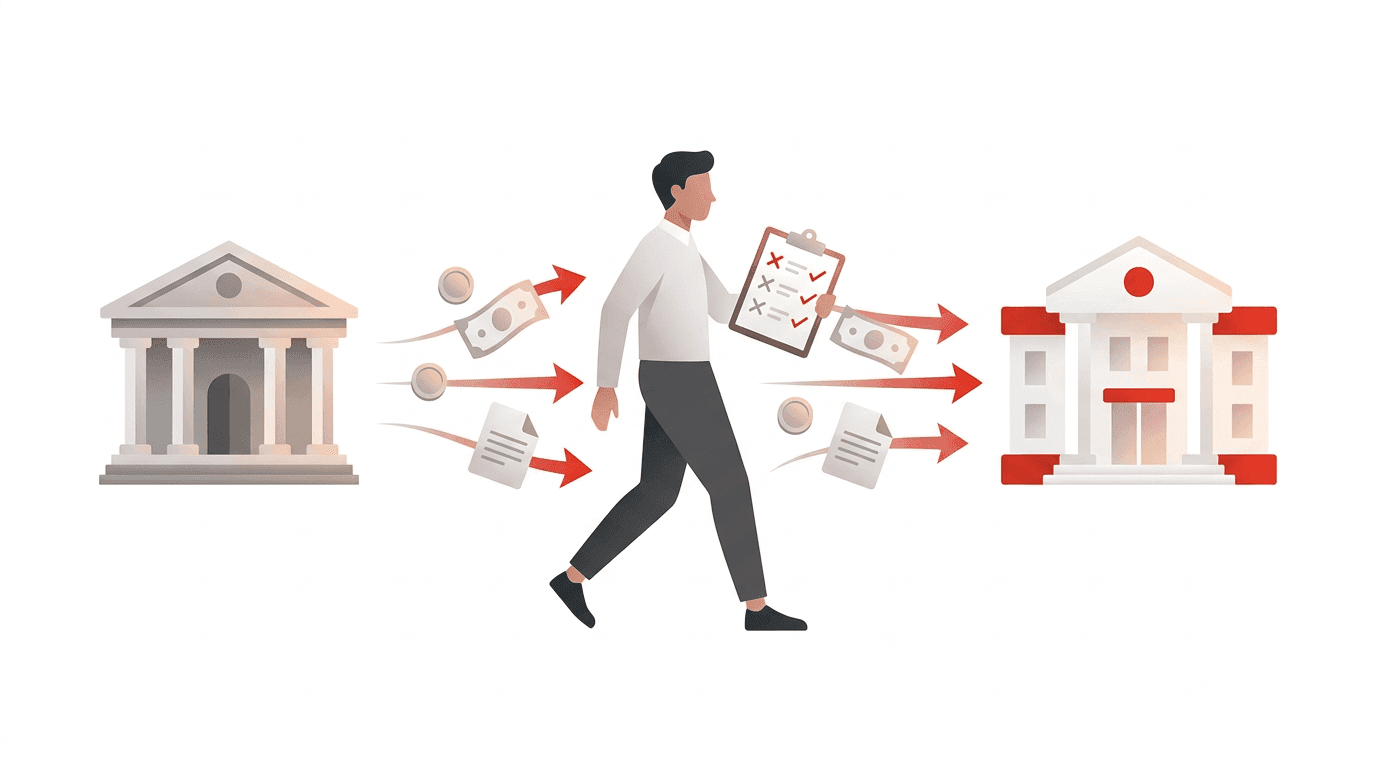
The average Swiss household pays CHF 100 to CHF 300 per year in banking fees they could avoid entirely. Yet most people never switch because they assume the process is complicated. It's not. The whole thing takes about 2 hours of actual work, spread over a few weeks. Here's exactly how to do it without losing a single franc.
How to switch your bank account in Switzerland
The process is straightforward, but the order matters. Open the new account first, run both in parallel for 4 to 8 weeks, then close the old one. Rushing the closure is how people miss payments and get hit with fees.
Before you do anything, figure out where you're going. Compare account fees, debit card costs, and features using our bank account comparison tool. If you're not sure what type of account suits you, try our account finder. The best free options include Yuh (CHF 0 for everything), Neon (CHF 0 account, CHF 20/year debit card), and Zak by Bank Cler (CHF 0 for everything including budgeting tools).
Most neobanks let you open an account in 10 to 15 minutes via their app. Traditional banks take a bit longer but many now offer fully online account opening. You'll need your Swiss ID or passport and, for non-Swiss residents, your residence permit. Don't close anything yet.
This is the step most people underestimate. You need to move over your standing orders (Daueraufträge), eBill connections, and any LSV/direct debit mandates. Log into eBill on your new bank's e-banking platform using the same email address you used before. Your existing eBill connections will transfer automatically.
Tell your employer to send your salary to the new IBAN. Update your bank details with the tax office, health insurance, landlord, and any other institutions that send you money or collect payments. Make a list and check them off one by one.
Keep the old account open and funded. Watch it for any incoming or outgoing payments you missed. If something still comes through the old account after a month, redirect it. This buffer period is your safety net.
Once you're confident nothing is coming through the old account, send a written cancellation letter (signed, by post or e-banking). Transfer any remaining balance to your new account. Most banks process the closure within a few business days. Some charge a closure fee (typically CHF 10 to CHF 20), though the majority of Swiss banks close accounts for free.
How to close a Swiss bank account
Closing an account requires a signed written request. Most Swiss banks accept a simple letter or an e-banking message. There's no legal notice period for standard private accounts in Switzerland, which means you can close your account at any time.
Here's what the letter should include:
- Your full name and address
- Your account number(s) and IBAN
- A clear statement that you want to close the account and cancel all associated services
- The IBAN of your new bank for the remaining balance transfer
- Your signature and date
Some banks provide a closure form on their website. Others accept a freeform letter. Either works. Send it by registered mail if you want proof of delivery.
What about savings accounts? This is where it gets tricky. Savings accounts often have withdrawal limits. Exceeding the free withdrawal amount triggers penalty interest (Strafzins). Typical limits are CHF 10,000 to CHF 50,000 per year, depending on the bank. If your savings balance exceeds the free limit, you may need to withdraw in stages over several months to avoid penalties.
What does it cost to close a bank account in Switzerland?
Most Swiss banks close accounts for free. Based on our database of 76 bank accounts, the vast majority charge CHF 0 for account closure. But there are exceptions.
Banks that charge closure fees include Cantonal Bank of Basel (BKB) at CHF 20, Cantonal Bank of Zug at CHF 20, Cantonal Bank of Jura (BCJ) at CHF 12, and Cantonal Bank of Schwyz (SZKB) at CHF 10. Every other bank in our comparison charges nothing.
The bigger cost risk isn't the closure fee itself. It's the penalty interest on savings withdrawals and any missed payments during the transition. A single bounced direct debit can cost more than the closure fee.
How long does a bank switch take in Switzerland?
Plan for 4 to 8 weeks from start to finish. Here's a realistic timeline:
- Week 1: Open new account, receive debit card (3 to 7 days for physical card; virtual cards are instant at most neobanks)
- Week 1 to 2: Transfer eBill, standing orders, and direct debits
- Week 2 to 3: Notify employer, tax office, insurance, landlord
- Week 3 to 8: Parallel operation, watching for stray payments
- Week 6 to 8: Close the old account once you're confident everything has moved
Some bank switching services (offered by UBS, Raiffeisen, BKB, Bank Cler, and others) can speed this up by handling the cancellation letters and payment transfers for you. These services are typically free when you open a new account with the offering bank.
Banks with switching services in Switzerland
Several Swiss banks offer dedicated switching assistance to make the process easier. They'll prepare cancellation letters, help transfer your payment infrastructure, and guide you through the transition.

UBS's Bankwechsel-Service handles all administrative tasks. They draft cancellation letters and coordinate the transfer with your old bank.

Raiffeisen offers branch-based switching support. An advisor walks you through the process and handles the paperwork.

Bank Cler provides a switching checklist and letter templates. Zak users get the same support through the app.
Where should you switch to? Best bank accounts in 2026
The right account depends on what frustrated you about your current bank. Here are the most common reasons people switch and the best alternatives for each.
Switching because of high fees? Go with a free neobank. Yuh, Neon, and Zak all offer CHF 0 account management and CHF 0 (or close to it) debit card fees. Migros Bank is the best free option if you want a traditional bank with branches.
Switching because of poor digital experience? Neon and Yuh have the best mobile apps in Switzerland. If you want a traditional bank with strong digital tools, UBS key4 and Zak by Bank Cler are solid choices.
Switching because you need better savings rates? Compare savings accounts separately from your daily account. There's no rule saying both need to be at the same bank. Our best bank accounts comparison shows you which banks offer the strongest combination of low fees and competitive rates.
Expert recommendation
I've switched banks twice in Switzerland, and both times I wished I'd done it sooner. The mental friction of switching is way bigger than the actual work involved.
Here's my honest advice: don't overthink it. Open a free account at Yuh or Neon today. It takes 10 minutes and costs nothing. Then take your time transferring everything over the next month. The parallel account approach removes all risk.
If you're leaving UBS, PostFinance, or a cantonal bank because of fees, you'll likely save CHF 100 to CHF 200 per year by switching to a free neobank. That's real money for 2 hours of work. And if you find you miss branch access or specific services, you can always keep the old account as a secondary option while using the neobank as your daily driver.
One thing that surprised me: the eBill transfer is now seamless. Use the same email at your new bank and all your billers follow you automatically. That alone removes 80% of the switching hassle.

Common mistakes when switching bank accounts
The number one mistake. If you close your old account before all standing orders and direct debits are redirected, payments will bounce. Keep the old account open for at least 4 to 6 weeks after you've moved everything. Check it weekly for stray transactions.
Savings accounts have penalty-free withdrawal limits. If you withdraw everything at once, you could face penalty interest of 0.5% to 2% on the amount exceeding the limit. Check your bank's conditions and plan withdrawals across multiple periods if necessary.
It's easy to miss one or two places. Tax refunds, employer salary payments, insurance reimbursements, and subscription services all need your new IBAN. Make a complete list before you start the switch.
They don't. Credit cards issued by your old bank need to be cancelled separately. If you want to keep your credit card, check whether it can continue independently of the bank account. Many Swiss credit cards (especially from Swisscard or Cembra) are not tied to a specific bank.
UBS, Raiffeisen, Bank Cler, and most cantonal banks offer free switching assistance. They'll draft your cancellation letters and coordinate the transfer. If you're moving to one of these banks, take advantage of it.
Frequently asked questions
How do I close my bank account in Switzerland?
Send a signed written cancellation letter to your bank. Include your name, account number, IBAN, and the IBAN of your new bank for the remaining balance transfer. There's no legal notice period for standard private accounts. Most banks process the closure within a few business days and charge no fee.
Does it cost money to close a Swiss bank account?
Usually not. The vast majority of Swiss banks close accounts for free. A few cantonal banks charge CHF 10 to CHF 20 as a closure fee (for example, BKB and Cantonal Bank of Zug charge CHF 20). The bigger risk is penalty interest on savings accounts if you exceed the withdrawal limit.
How long does it take to switch banks in Switzerland?
Plan for 4 to 8 weeks total. Opening a new account takes minutes. Transferring payments, eBill, and standing orders takes 1 to 2 weeks. The parallel operation period should last at least 4 weeks. The actual account closure happens in a few business days.
Can I switch banks online in Switzerland?
Yes. You can open a new account fully online at most banks, including neobanks (Neon, Yuh, Zak) and many traditional banks (UBS key4, Raiffeisen, PostFinance). The closure of your old account typically requires a signed letter, which some banks accept via e-banking.
What happens to my eBill when I switch banks?
It transfers automatically. When you activate eBill on your new bank's e-banking using the same email address, your existing biller connections transfer with you. This is one of the biggest improvements in Swiss banking over the past few years and removes a major switching friction point.