

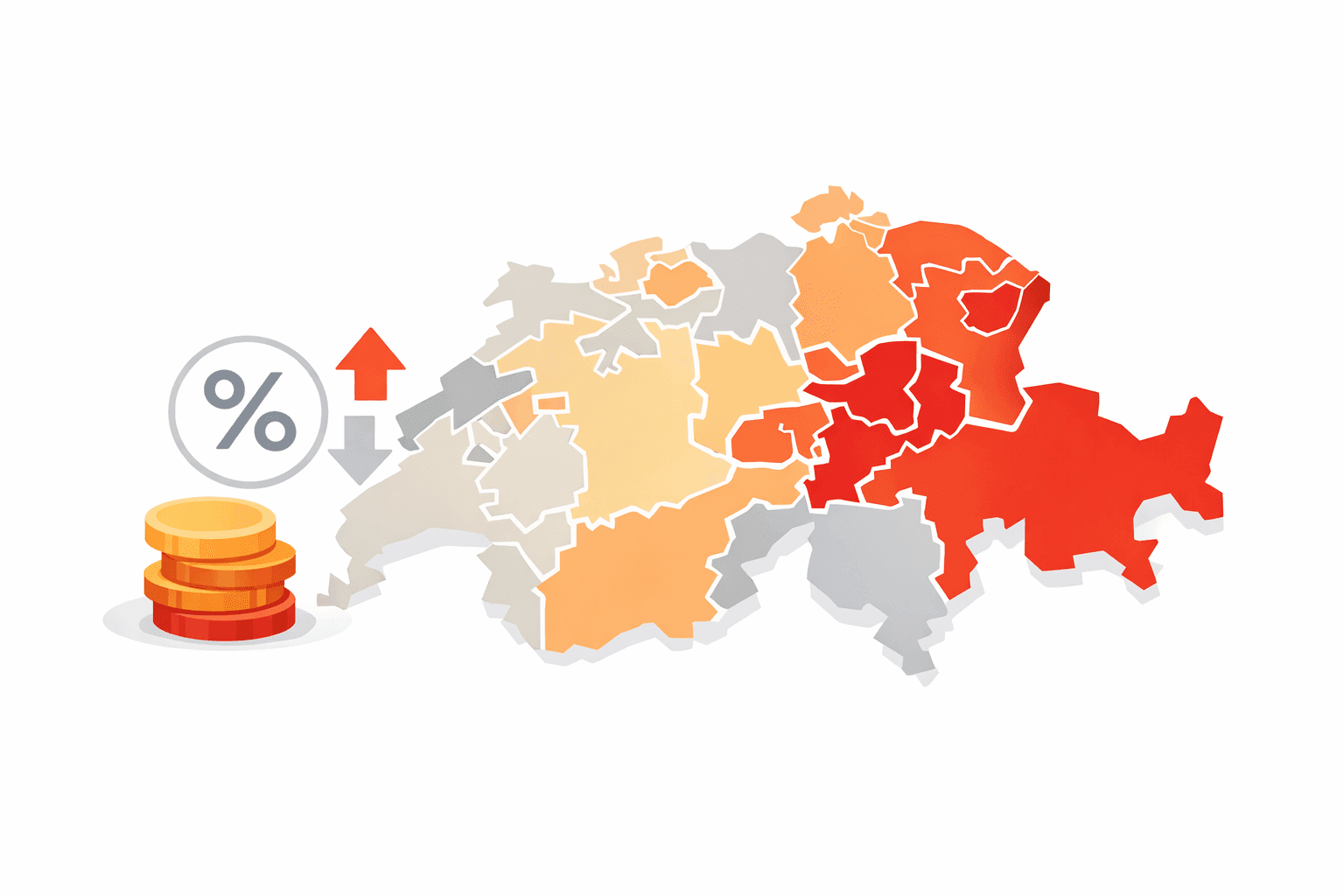
The difference between the cheapest and most expensive canton for pillar 3a withdrawal taxes is staggering. On a CHF 150,000 payout, you'd pay roughly CHF 2,000 in Schwyz but over CHF 10,000 in Basel. That's an CHF 8,000 gap for the exact same retirement savings, determined entirely by where you live when you cash out. Most people never think about this until it's too late.
How Are Pillar 3a Withdrawals Taxed in Switzerland?
When you withdraw money from your pillar 3a, it's taxed as a capital benefit ("Kapitalleistung"), not as regular income. This is good news: the tax rate is significantly lower than your normal income tax rate.
The tax is levied at three levels:
- Federal tax: 1/5 of the regular income tax rate. This is the same everywhere in Switzerland.
- Cantonal tax: Varies dramatically. Some cantons use a flat rate, others apply progressive rates that increase with the withdrawal amount.
- Municipal tax: Typically a multiplier on the cantonal rate. Your specific municipality matters.
Church tax may also apply unless you've formally left your church. The three levels combined create a total effective tax rate that ranges from about 1.1% to over 15% depending on the amount and your location.
The federal portion is relatively small. On CHF 100,000, federal tax is roughly CHF 770. The cantonal and municipal taxes are where the real differences emerge.
Pillar 3a Withdrawal Tax Rates by Canton
Here's what you'd actually pay in each canton on different withdrawal amounts. These figures use the cantonal capital city, single person, age 65, no church affiliation:
| Canton | CHF 50,000 | CHF 100,000 | CHF 150,000 | CHF 250,000 | CHF 500,000 |
|---|---|---|---|---|---|
| SZ (Schwyz) | 1.1% | 2.2% | 3.2% | 5.3% | 7.8% |
| SH (Schaffhausen) | 2.0% | 3.2% | 3.8% | 4.8% | 5.4% |
| GR (Chur) | 2.9% | 3.3% | 3.7% | 4.3% | 5.8% |
| FR (Fribourg) | 2.0% | 3.2% | 4.5% | 7.0% | 9.3% |
| ZG (Zug) | 1.8% | 2.8% | 3.4% | 4.6% | 5.8% |
| LU (Lucerne) | 2.3% | 3.8% | 4.4% | 5.5% | 6.2% |
| NW (Stans) | 2.7% | 3.6% | 4.2% | 5.0% | 5.6% |
| AI (Appenzell) | 2.4% | 3.3% | 3.8% | 4.6% | 5.1% |
| AG (Aarau) | 3.1% | 4.9% | 5.7% | 7.1% | 8.2% |
| BE (Bern) | 3.5% | 4.6% | 5.5% | 6.5% | 8.3% |
| VD (Lausanne) | 3.3% | 4.6% | 5.6% | 7.0% | 8.4% |
| GE (Geneva) | 2.5% | 4.1% | 5.0% | 6.2% | 7.4% |
| BS (Basel) | 3.7% | 5.3% | 6.4% | 8.3% | 9.5% |
| ZH (Zurich) | 4.5% | 4.9% | 5.3% | 5.9% | 7.2% |
| TG (Frauenfeld) | 6.2% | 6.6% | 7.0% | 7.6% | 8.2% |
| AR (Herisau) | 7.6% | 7.9% | 8.3% | 9.0% | 9.9% |
Source: Swiss Federal Tax Calculator. Rates for 2025 tax year, single, age 65, no church affiliation.
Key takeaway: On CHF 150,000, the difference between Schwyz (CHF 4,800) and Appenzell Ausserrhoden (CHF 12,450) is roughly CHF 7,650. That's real money that stays in your pocket or goes to the tax authority, depending entirely on your canton.
Why Do Cantonal Tax Rates Differ So Much?
Each canton sets its own rules for taxing capital benefits. There are three fundamentally different approaches:
Progressive systems (most cantons): The tax rate increases as the withdrawal amount grows. A CHF 50,000 withdrawal might be taxed at 2%, but CHF 500,000 at 8%. This is the most common model and the reason staggered withdrawals save money.
Linear (flat) systems (Glarus, Obwalden, St. Gallen, Thurgau, Uri): A fixed percentage applies regardless of the amount. Whether you withdraw CHF 50,000 or CHF 500,000, the cantonal rate stays the same. In these cantons, staggering withdrawals across years doesn't reduce cantonal taxes (though it still helps with federal taxes).
Mixed systems (e.g., Basel-Landschaft): A flat rate up to a threshold, then a higher rate above it. Basel-Landschaft charges 2% on the first CHF 400,000 and 6% on the excess, capped at 4.5% total.
Understanding which system your canton uses is critical for planning your withdrawal strategy. If you live in a progressive canton like Bern or Zurich, staggering saves you thousands. If you're in Thurgau or St. Gallen, the cantonal portion stays flat regardless.
How the 3a Tax Deduction Works (Saving Phase)
Before you even think about withdrawal taxes, your 3a delivers tax savings during the contribution phase. Every franc you put into pillar 3a is deducted from your taxable income. For 2026, that's up to CHF 7,258 for employees with a pension fund.
The deduction value depends on your marginal tax rate, which again varies by canton:
In Geneva, Lausanne, or Basel, contributing CHF 7,258 saves you roughly CHF 2,200 to CHF 2,500 annually on a CHF 100,000 income. The higher your canton's marginal rate, the more the deduction is worth.
In Zurich, Bern, or Lucerne, the same contribution saves roughly CHF 1,800 to CHF 2,100. Still a significant tax break.
In Zug or Schwyz, savings are lower in absolute terms at CHF 1,200 to CHF 1,500. But even here, the 3a remains the single best legal tax optimization available.
Over a 30-year career, the annual deduction alone saves you CHF 36,000 to CHF 75,000 in taxes depending on your canton. That's before any investment returns on the contributed amount.
Use our pillar 3a calculator to see your exact annual tax savings based on your income and municipality.
How to Minimize Pillar 3a Withdrawal Taxes
Here's where strategic planning pays off. There are several proven strategies to reduce your tax bill at withdrawal:
Open Multiple 3a Accounts
A 3a account must be withdrawn in full. You can't take partial withdrawals (except for property purchases). If you have CHF 200,000 in one account, you pay taxes on the entire amount at once, hitting higher progressive rates.
Split it across 4-5 accounts of CHF 40,000-50,000 each, and withdraw them in different tax years. In a progressive canton like Basel, this can save you CHF 3,000 to CHF 5,000 compared to a single lump-sum withdrawal.
Stagger Withdrawals Over Multiple Years
You can start withdrawing pillar 3a up to 5 years before your AHV retirement age. If you continue working past retirement age, you can delay up to 5 years after. That gives you a potential 11-year window to spread withdrawals.
Critical detail: All capital benefits withdrawn in the same year are added together for tax purposes. This includes pillar 3a, pension fund capital (2nd pillar), and vested benefits. Your spouse's withdrawals are also added in most cantons. Coordinate with your partner to avoid stacking withdrawals in the same year.
Coordinate with 2nd Pillar Withdrawals
If you're also taking a lump-sum from your pension fund, plan carefully. Withdrawing CHF 100,000 from 3a and CHF 200,000 from your pension fund in the same year means you're taxed on CHF 300,000 combined. Spread them across different years whenever possible.
Consider Relocation (for Large Amounts)
For very large combined pension assets (CHF 500,000+), the tax difference between cantons can exceed CHF 20,000. Some people relocate to a low-tax canton like Schwyz or Appenzell Innerrhoden before withdrawing. This is legal and legitimate, though you need to genuinely establish residence.
For those moving abroad, a withholding tax ("Quellensteuer") applies instead. The rate depends on the canton where your 3a foundation is domiciled, not your former residence. Some providers like finpension are domiciled in Schwyz, which has one of the lowest withholding tax rates. For details on when and how you can withdraw, see our pillar 3a withdrawal rules guide.
What About the New Backpayment Rule and Taxes?
Starting in 2026, you can retroactively contribute for years you missed since 2025. These backpayments are tax-deductible in the year you make them, which effectively lets you boost your tax deduction beyond the regular CHF 7,258 limit for a single year.
But there's a catch for withdrawal planning. Once you start withdrawing 3a funds (from age 60), you lose the right to make further backpayments, even if you have remaining gaps. This means you need to complete all backpayments before your first withdrawal.
The interaction between backpayments and withdrawal tax optimization adds a new layer of planning. Contributing more now increases your total 3a balance, which could push you into higher withdrawal tax brackets if you don't open enough separate accounts to stagger properly.
Frequently Asked Questions
How much tax do I pay on a pillar 3a withdrawal of CHF 100,000?
It depends entirely on your canton and municipality. At the federal level, you'd pay approximately CHF 770. Cantonal and municipal taxes range from about CHF 1,400 (Schwyz) to CHF 4,500 (Appenzell Ausserrhoden). For a single person in Zurich city, the total comes to roughly CHF 4,900. Use the Swiss Federal Tax Calculator for your exact amount.
Can I reduce pillar 3a taxes by opening multiple accounts?
Yes. Since a 3a account must be withdrawn entirely at once, having multiple accounts lets you spread withdrawals across different tax years. In cantons with progressive tax rates (most cantons), this lowers your effective tax rate. The savings can be CHF 3,000 to CHF 5,000 or more for balances above CHF 150,000. Open 4-5 accounts from the start of your career.
Are pillar 3a contributions tax-deductible in all cantons?
Yes. Pillar 3a contributions are fully deductible from your taxable income in every Swiss canton, up to the annual maximum (CHF 7,258 for employees with a pension fund in 2026). The actual CHF amount you save differs by canton because tax rates vary, but the deduction applies everywhere at both the federal and cantonal level.
When is the best time to withdraw pillar 3a to minimize taxes?
Start withdrawing 5 years before your AHV retirement age if possible. Withdraw one account per year. Avoid withdrawing in the same year your spouse does (most cantons aggregate spousal capital benefits). Never withdraw 3a and pension fund capital in the same year if you can avoid it. The goal is to keep each year's total capital benefit as low as possible to stay in lower tax brackets. See our near-retirement planning guide for a complete year-by-year checklist.
Does the 3a tax deduction differ between cantons?
The deduction percentage is always 100% of your contribution (up to the limit). But the tax savings in CHF differ because cantonal tax rates vary. In Geneva (high taxes), the CHF 7,258 deduction saves about CHF 2,500. In Zug (low taxes), it saves about CHF 1,300. The deduction is most valuable in high-tax cantons.
After optimizing my own retirement savings for years, I can tell you the cantonal tax difference is the single most underappreciated factor in Swiss retirement planning. Most people focus on choosing the right 3a provider (which matters), but completely ignore the CHF 5,000 to CHF 10,000 they could save through smart withdrawal timing. My advice: open 5 separate 3a accounts from day one. Start withdrawing 5 years before retirement. Never overlap with your spouse's withdrawals. And if you're planning to move cantons near retirement, check the withdrawal tax rates before you decide where. These simple steps can save you the equivalent of a year's worth of 3a contributions in taxes alone.

Common Mistakes with 3a Withdrawal Taxes
The most expensive mistake. With CHF 200,000 in one account, you're forced to withdraw it all at once, hitting the highest progressive tax brackets. Split across 4-5 accounts and withdraw over multiple years. In Basel, this alone can save CHF 4,000 to CHF 5,000.
All capital benefits in the same year are aggregated for tax purposes. Withdrawing CHF 100,000 from 3a plus CHF 300,000 from your pension fund means you're taxed on CHF 400,000 combined. Stagger these across different years. The savings can be CHF 5,000 to CHF 10,000.
If your canton uses flat-rate taxation (Glarus, Obwalden, St. Gallen, Thurgau, Uri), staggering across years doesn't reduce the cantonal portion. Your strategy should differ based on whether your canton is progressive or flat. Check before you plan.
In most Swiss cantons, both spouses' capital benefits are combined for tax calculation. If you both withdraw in the same year, the total amount pushes into higher brackets. Alternate years between spouses for maximum savings.