


Most Swiss workers don't start thinking about their 3a withdrawal strategy until a year or two before retirement. By then, they've already missed the window to split accounts, stagger withdrawals, and save thousands of francs in taxes. If you're 55 or older, this article is your playbook.
When Should You Start Planning Your 3a Withdrawal?
The honest answer: 5 to 10 years before retirement. Not 1 year. Not 6 months. A decade.
The reason is simple. Swiss tax law lets you withdraw each 3a account only as a lump sum. No partial withdrawals. If you have one account with CHF 150,000, you withdraw CHF 150,000 in a single tax year, and the full amount gets hit by progressive capital withdrawal tax.
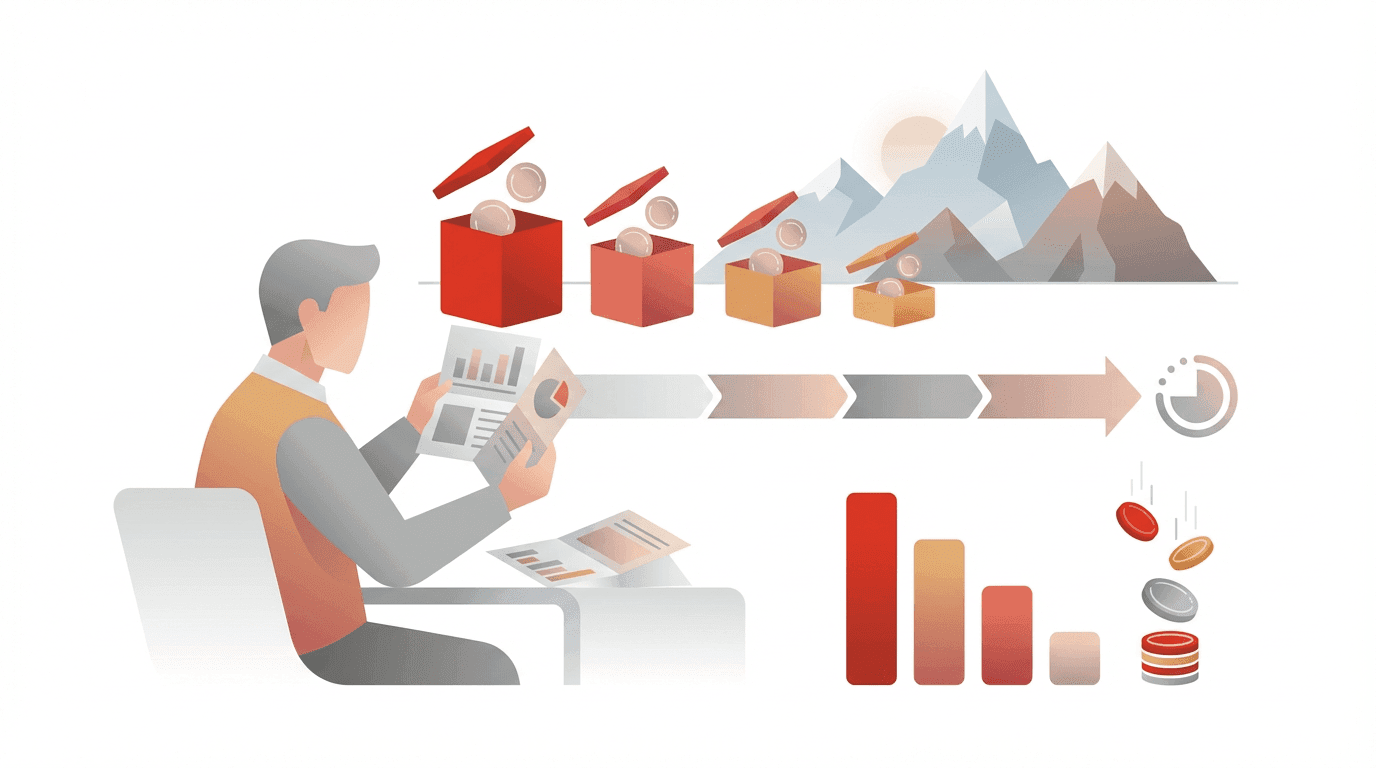
But if you have five accounts with CHF 30,000 each, you can withdraw one per year over five years. Each withdrawal is taxed separately at a lower rate. The difference? Easily CHF 5,000 to CHF 20,000 in tax savings depending on your canton and total balance.
The catch: you need those multiple accounts to exist years before withdrawal. Opening a new 3a account and immediately withdrawing it in the same year looks like tax avoidance, and some cantons won't allow it. The earlier you split, the safer you are.
Since the AHV21 reform, the reference age for retirement is 65 for both men and women. You can start withdrawing 3a funds at age 60 (five years before reference age). If you keep working past 65, you can delay withdrawal up to age 70.
How Staggered 3a Withdrawals Save You Thousands
This is the single most impactful strategy for anyone approaching retirement with 3a savings. Let's look at real numbers.
Example: Stefan vs. Katharina, both living in Zurich
Stefan has one 3a account with CHF 200,000. He withdraws everything at age 65. His capital withdrawal tax: approximately CHF 17,800.
Katharina has four 3a accounts with CHF 50,000 each. She withdraws one account per year from age 62 to 65. Her total tax across four years: approximately CHF 9,200.
Katharina saves CHF 8,600 by doing nothing more than splitting her 3a into multiple accounts and withdrawing over four years instead of one.
The savings are even more dramatic if you also receive a lump sum from your pension fund (2nd pillar) in the same year. Capital from the 2nd and 3rd pillars is aggregated for tax purposes within the same tax year. Withdrawing your 3a in a different year than your pension fund capital avoids stacking the progressive rate.
Tax rates vary wildly by canton
The tax you pay on 3a capital withdrawal depends on where you live. On a CHF 200,000 withdrawal, the difference between cantons can be striking:
- Schwyz (Freienbach): ~CHF 5,200
- Zug: ~CHF 6,800
- Zurich (city): ~CHF 17,800
- Bern: ~CHF 16,500
- Basel-Stadt: ~CHF 18,900
Some retirees move to a tax-favorable canton before withdrawing. It's a legitimate strategy, though it requires actually living there. The tax authorities can challenge withdrawals made right after a move if it looks like a purely tax-motivated relocation.
For a detailed breakdown of cantonal tax rates on 3a withdrawals, see our cantonal tax guide.
De-Risking Your 3a Portfolio Before Retirement
If your 3a money is invested in equity funds (which it should be for most of your career), you need to gradually shift toward lower-risk options as retirement approaches. This is called de-risking, and getting the timing wrong can cost you years of gains or expose you to a painful last-minute crash.
The general framework
10+ years to retirement: Stay invested. High-equity strategies (80-99% stocks) are appropriate. Markets have recovered from every major downturn within this timeframe historically. Providers like Finpension and VIAC offer strategies with up to 99% equity exposure at low cost (0.39-0.44% total fees).
5-10 years to retirement: Start reducing equity exposure gradually. Move from a 99% equity strategy to 60-80%. This gives you a buffer against a major market downturn while still capturing growth. Most digital providers let you adjust your strategy with a few taps.
3-5 years to retirement: Shift to a balanced or conservative strategy (20-40% equities). The money you'll need in 3-5 years should not be fully exposed to stock market volatility.
Under 3 years: Move to a savings account or very conservative allocation. Capital protection is your priority now. The best 3a savings accounts currently pay 0.50-0.65% interest. Not exciting, but your capital is guaranteed.
Stagger the de-risking across accounts
Here's a strategy most advisors don't mention: if you have multiple 3a accounts (which you should for tax reasons), you don't need to de-risk all of them at the same time.
The account you plan to withdraw first (at age 60 or 61) should be in a savings account or low-risk fund. The account you'll withdraw last (at age 64 or 65) can stay invested in equities longer because it has more time.
This way, you capture additional returns on the later accounts without risking the ones you need first. It's a simple optimization that can add several thousand francs to your total payout.
Your 3a Pre-Retirement Checklist
Open multiple 3a accounts if you haven't already. You can have up to 5 accounts per provider (Finpension, VIAC) and there's no legal maximum on total accounts. Aim for 3-5 accounts. Split your existing balance by transferring portions to new accounts.
Start thinking about withdrawal sequence. Map out which years you'll withdraw each account. Coordinate with your spouse's planned withdrawals to avoid overlap.
Review your equity allocation. If you're still in a high-equity strategy, you have time. No need to panic. But start planning the de-risking timeline.
Check your contribution limits. You can still contribute CHF 7,258 per year (or CHF 36,288 if self-employed without a pension fund). Keep contributing. Every year of tax deductions counts, even this close to retirement.
Begin staggered withdrawals if age allows. You can withdraw from age 60 onward. If you have 5 accounts, consider withdrawing the first one now.
De-risk the accounts you'll withdraw first. Move the next-to-withdraw account to a savings strategy or conservative allocation. Leave later accounts invested.
Coordinate with your pension fund. Find out when your 2nd pillar payout will happen. Make sure your 3a withdrawals fall in different tax years from your pension fund capital withdrawal.
Get a tax projection. Run the numbers for your specific canton. The tax difference between withdrawing CHF 50,000 per year vs. CHF 200,000 in one year is significant.
Finalize your withdrawal timeline. Confirm exact dates with your 3a providers. Some banks need 30-90 days notice.
Make your final 3a contribution. You can contribute to pillar 3a in the year of retirement, as long as you're still earning income and contribute before the withdrawal date. This gives you one last tax deduction.
Move remaining invested accounts to safety. Any money you'll withdraw within 12 months should be in a savings account, not equities.
Verify your AHV situation. Confirm your retirement date with your AHV office. Check for any contribution gaps that could reduce your AHV pension.
How Is a 3a Withdrawal Taxed?
When you withdraw your pillar 3a, the amount is taxed separately from your regular income at a reduced rate. Here's what you need to know.
Federal tax: One-fifth of the regular income tax rate applies. On CHF 100,000, the federal portion is roughly CHF 1,900.
Cantonal and municipal tax: This varies enormously. Some cantons (like Schwyz) apply flat rates as low as 2-3%. Others (like Basel-Stadt) use progressive rates that can reach 8-10% on larger amounts.
The progressive trap: This is why staggering matters. If you withdraw CHF 50,000, you might pay 4% total tax. Withdraw CHF 200,000, and you might pay 7%. The tax rate increases with the amount because of progression. Splitting into multiple smaller withdrawals keeps each one in the lower brackets.
Married couples: Both spouses' capital withdrawals in the same year are added together. If you withdraw CHF 100,000 and your spouse withdraws CHF 100,000, you're taxed on CHF 200,000 combined, at the higher progressive rate.
Pension fund coordination: Any 2nd pillar capital (pension fund lump sum) withdrawn in the same year is added to your 3a withdrawal for tax calculation. This is the most expensive mistake people make. Always withdraw pension fund capital and 3a in different years.
Coordinating Your 3a with AHV and Pension Fund
Your 3a doesn't exist in a vacuum. It's one piece of a three-pillar system, and optimizing it requires thinking about all three together.
AHV (1st pillar): Your AHV pension starts at age 65 (reference age). You can defer it up to age 70 for a higher monthly amount (6.8% increase per year of deferral) or take it early from age 63 (with a 6.8% reduction per year). If you have substantial 3a savings, deferring AHV can make sense because you live off 3a withdrawals while your AHV pension grows.
Pension fund (2nd pillar): Most pension funds offer a choice between a lifelong pension (annuity) and a lump sum capital withdrawal. Some offer a mix. The key coordination point: never withdraw 2nd pillar capital and 3a capital in the same tax year. Plan which year you take your pension fund capital and schedule 3a withdrawals around it.
Practical coordination strategy: Withdraw your first 3a account at age 60-61. Take your pension fund capital at age 63-64. Withdraw remaining 3a accounts at age 62 and 65. Start AHV at 65 or defer. This spreads capital withdrawals across multiple years and minimizes the progressive tax hit.
For more on how to open and manage multiple 3a accounts, see our dedicated guide.
After helping thousands of users optimize their 3a strategy on GetRates, here's the pattern I see: people who plan 5+ years ahead save CHF 10,000 to CHF 20,000 in taxes compared to those who do nothing. That's real money, and it requires almost no effort beyond opening a few accounts and scheduling withdrawals.
The biggest regret I hear from retirees is "I wish I'd split my 3a accounts earlier." You can't go back in time. If you're reading this at age 55, you're in the sweet spot. Open 3-5 accounts today, spread your contributions, and map out a withdrawal timeline. Your future self will thank you.
One thing the industry doesn't talk about enough: the de-risking question is personal. I've seen people panic-sell their 3a investments 5 years before retirement because of a market dip, missing the recovery entirely. If your 3a is money you won't touch for 5+ years, keeping it invested in a diversified equity fund is still rational. Only de-risk what you'll actually need soon.

Common Mistakes Near Retirement
This is the number one mistake. With a single account, you withdraw everything in one year, paying the highest possible progressive tax rate. You also can't coordinate around your pension fund capital withdrawal. Open multiple accounts as early as possible. Providers like Finpension and VIAC let you hold up to 5 accounts each. Even if you only have 3-5 years left, splitting now is better than not splitting at all.
This combines both amounts for tax purposes, pushing you into much higher tax brackets. A retiree in Zurich withdrawing CHF 200,000 from their pension fund and CHF 100,000 from their 3a in the same year pays roughly CHF 8,000 more in taxes than if they split across two years. Always plan your 2nd and 3rd pillar withdrawals in separate tax years.
On a CHF 200,000 3a withdrawal, the tax difference between Schwyz and Basel-Stadt is over CHF 13,000. If you're flexible on where you live in the years before retirement, researching tax-favorable cantons is worth your time. Even within the same canton, some municipalities have significantly different rates.
Selling all your equity investments 10 years before retirement costs you years of compounding. But staying fully invested until age 64 exposes you to a potential 20-30% market crash right when you need the money. The solution: de-risk gradually, starting 5-7 years out, and stagger the timing across accounts.
You can contribute to pillar 3a in the year you retire, as long as you contribute before your withdrawal date and still have earned income. That's one last tax deduction of CHF 7,258 against your income. Don't leave it on the table.
Frequently Asked Questions
When can I start withdrawing my pillar 3a?
You can withdraw your pillar 3a starting 5 years before the reference retirement age, which is currently 65 for both men and women since the AHV21 reform. That means the earliest withdrawal age is 60. If you continue working past 65, you can delay withdrawal up to age 70. Each 3a account must be withdrawn completely as a lump sum. For a full overview of every withdrawal scenario, see our pillar 3a withdrawal rules guide.
How much tax do I pay on a 3a withdrawal?
The tax depends on the amount withdrawn and your canton of residence. On CHF 100,000, you might pay between CHF 3,000 (Schwyz) and CHF 10,000 (Basel-Stadt). Federal tax is one-fifth of the ordinary income tax rate. Cantonal rates vary significantly. Married couples' withdrawals in the same year are combined for tax purposes. Use staggered withdrawals across multiple years to reduce the progressive tax rate.
How many pillar 3a accounts should I have before retirement?
Aim for 3 to 5 accounts. Each account must be withdrawn as a lump sum in a single tax year, so having multiple accounts lets you spread withdrawals across years and reduce your tax burden through lower progressive rates. Providers like VIAC and Finpension allow up to 5 accounts each. Start splitting at least 5 years before retirement.
Should I switch my 3a from investment funds to savings before retirement?
It depends on your timeline. Money you'll withdraw within 3 years should be in a savings account or very conservative fund to protect against market downturns. Money you won't touch for 5+ years can remain in equities. A smart approach: de-risk gradually, account by account. Move the first-to-withdraw account to safety while leaving later accounts invested for continued growth.
Can I contribute to pillar 3a in the year I retire?
Yes. You can make a 3a contribution in your retirement year as long as you still have AHV-liable earned income and you contribute before the withdrawal date. The maximum contribution remains CHF 7,258 for employees with a pension fund. This gives you one final tax deduction, so don't skip it.