


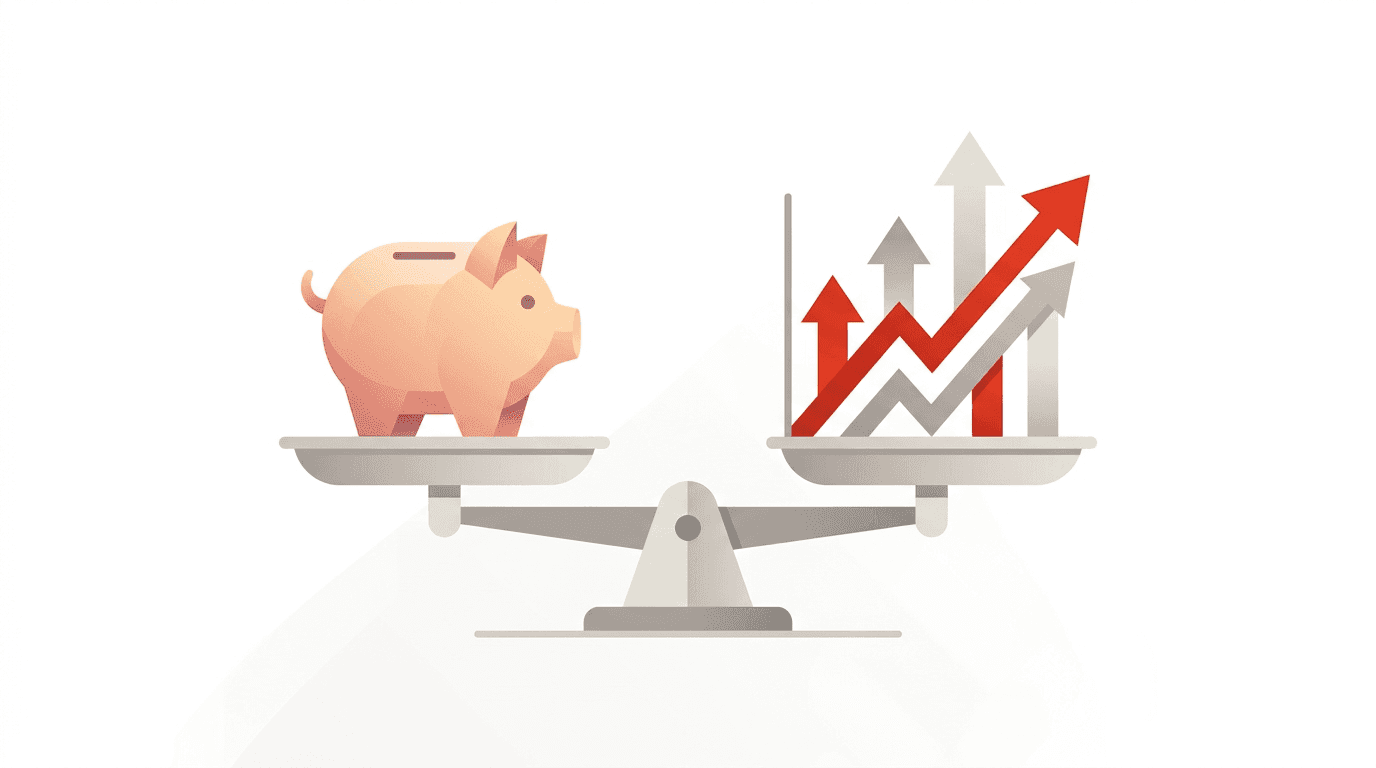
The average 3a savings account in Switzerland pays 0.26% interest. The average high-equity 3a investment fund returned over 8% last year. Over a 30-year career, that gap turns into a difference of more than CHF 250,000 on the same annual contribution. If you're still parking your pillar 3a money in a savings account without questioning it, this article is for you.
Pillar 3a Savings Account vs Investment Fund: The Quick Verdict
You have two options when you pay into pillar 3a: leave the money in a savings account or invest it in funds. Both get the same tax deduction. Both are locked until retirement (with a few exceptions). The difference is entirely in how your money grows.
- Average interest rate: 0.26% (best: 0.65%)
- Risk: None (capital is guaranteed)
- Best for: Short time horizon, risk-averse, near retirement
- CHF 7,258/year for 30 years: ~CHF 225,000
- Compare savings accounts
- Average annual return: 5-8% (historical, equity-heavy)
- Risk: Value fluctuates with markets
- Best for: Long time horizon, growth-oriented, young investors
- CHF 7,258/year for 30 years: ~CHF 375,000-480,000
- Compare investment funds
The short version: If you have more than 10 years until retirement, investing beats saving in virtually every historical scenario. The longer your time horizon, the more dramatic the advantage. Below, you'll see exactly why.
What Does CHF 7,258 per Year Actually Grow To?
This is where theory becomes real money. Let's compare what happens when you contribute the maximum pillar 3a amount of CHF 7,258 every year under three scenarios.
Scenario 1: Savings account at 0.25% interest (close to the current average of 0.26%)
| Timeframe | Total Contributed | Balance | Interest Earned |
|---|---|---|---|
| 10 years | CHF 72,580 | CHF 73,500 | CHF 920 |
| 20 years | CHF 145,160 | CHF 148,800 | CHF 3,640 |
| 30 years | CHF 217,740 | CHF 225,200 | CHF 7,460 |
Scenario 2: Investment fund at 3.5% annual return (conservative estimate based on a balanced portfolio)
| Timeframe | Total Contributed | Balance | Returns Earned |
|---|---|---|---|
| 10 years | CHF 72,580 | CHF 85,100 | CHF 12,520 |
| 20 years | CHF 145,160 | CHF 205,200 | CHF 60,040 |
| 30 years | CHF 217,740 | CHF 374,700 | CHF 156,960 |
Scenario 3: Investment fund at 5% annual return (closer to what high-equity funds like VIAC Global 100 have delivered historically)
| Timeframe | Total Contributed | Balance | Returns Earned |
|---|---|---|---|
| 10 years | CHF 72,580 | CHF 91,300 | CHF 18,720 |
| 20 years | CHF 145,160 | CHF 240,000 | CHF 94,840 |
| 30 years | CHF 217,740 | CHF 482,300 | CHF 264,560 |
The 30-year difference between savings and investing at 5% is CHF 257,100. That's not a rounding error. That's a year of income for most Swiss households. And all of it grows tax-free inside your 3a.
The compound interest effect is the reason. In a savings account, you earn interest on interest, but at 0.25% the effect is barely visible. At 5%, compound returns generate more than CHF 264,000 in gains on CHF 217,740 of contributions.
Use our pillar 3a calculator to run these numbers with your own assumptions.
When Does a 3a Savings Account Make Sense?
Savings accounts are not always the wrong choice. There are specific situations where keeping your 3a in a savings account is the rational decision.
You're 5 years or less from retirement. With a short time horizon, you don't have time to recover from a market downturn. A savings account guarantees your capital is intact when you need to withdraw it. If you're 60 or older, keeping at least part of your 3a in savings is reasonable.
You need the money for a home purchase soon. If you plan to use your 3a for a property down payment within the next 3 to 5 years, a savings account protects you from having to sell investments at a loss.
You genuinely cannot handle market volatility. This is a personal factor that matters more than most financial advisors admit. If seeing your 3a balance drop 20% during a market correction would cause you to panic-sell or lose sleep, a savings account gives you peace of mind. That has real value.
You have very small balances. If you're just starting out and your 3a balance is under CHF 5,000, the absolute difference between savings and investing is small. Some providers charge minimum fees on investment accounts that eat into tiny balances disproportionately.
Even the best savings accounts today pay only 0.50% to 0.65%. After inflation (which has averaged around 1% in Switzerland over the past decade), your purchasing power is actually shrinking.
When Should You Invest Your Pillar 3a?
For most working-age people in Switzerland, investing your 3a is the better choice. Here's why.
You have more than 10 years until retirement. Historical data shows that over any 10-year period, a globally diversified equity portfolio has produced positive returns in the vast majority of cases. The longer you hold, the lower the risk of ending up with less than you started. At 20+ years, the probability of negative returns approaches zero.
You want your money to beat inflation. At 0.26% average savings interest and Swiss inflation around 1%, your real return is negative. Investment funds with equity exposure of 60% or more have historically beaten inflation by a wide margin.
You're comfortable with short-term fluctuations. Your 3a balance will go up and down. In 2022, many 3a equity funds lost 15-20%. By the end of 2025, most had fully recovered and then some. VIAC Global 100 returned 8.17% in the past year alone. If you can stay the course during downturns, investing rewards you.
The best 3a investment providers today charge between 0.39% and 0.44% in total fees. Finpension charges a flat 0.39% all-in. VIAC's effective cost is around 0.40-0.44%. Frankly charges 0.44%. These fees are dramatically lower than what traditional banks charge for comparable products.
If you're new to investing in a 3a context, our beginner's guide to 3a investing walks you through the first steps. Or go straight to finding the best 3a investment fund for your profile.
Can You Split Between Savings and Funds?
Yes, and many Swiss investors do exactly this. You can contribute part of your CHF 7,258 to a savings account and the rest to an investment fund, even within the same provider.
Conservative Split
70% savings, 30% investments
This split works for people who are 5 to 10 years from retirement or who want the security of a guaranteed base with some growth potential. You keep the majority safe while giving a portion the chance to grow.
At current rates, this translates to roughly CHF 5,080 in savings and CHF 2,178 in a fund each year.
Balanced Split
50% savings, 50% investments
A good middle ground for people in their 40s or early 50s who want growth but are starting to think about protecting their capital. This approach halves your downside risk while still capturing significant upside.
That's CHF 3,629 to each option per year.
Growth Split
20% savings, 80% investments
The right split for investors under 40 with a long time horizon. You keep a small emergency cushion in savings (useful if you're planning a property purchase in the medium term) while maximizing long-term growth.
That's CHF 1,452 in savings and CHF 5,806 in funds per year.
70% savings, 30% investments
This split works for people who are 5 to 10 years from retirement or who want the security of a guaranteed base with some growth potential. You keep the majority safe while giving a portion the chance to grow.
At current rates, this translates to roughly CHF 5,080 in savings and CHF 2,178 in a fund each year.
50% savings, 50% investments
A good middle ground for people in their 40s or early 50s who want growth but are starting to think about protecting their capital. This approach halves your downside risk while still capturing significant upside.
That's CHF 3,629 to each option per year.
20% savings, 80% investments
The right split for investors under 40 with a long time horizon. You keep a small emergency cushion in savings (useful if you're planning a property purchase in the medium term) while maximizing long-term growth.
That's CHF 1,452 in savings and CHF 5,806 in funds per year.
Pro tip: You can also use a multi-account strategy. Open one 3a savings account and separate 3a investment accounts. This gives you flexibility and also helps with tax-optimized staggered withdrawals at retirement.
How to Decide: A Simple Framework
The decision comes down to two factors: time horizon and risk tolerance. Everything else is secondary.
If you're under 40 and employed: Invest 80-100% in a high-equity 3a fund (80-99% stocks). You have 20+ years for compounding to work. The historical data overwhelmingly favors this approach. Choose a low-cost provider like Finpension (0.39% all-in) or VIAC (comparable total cost). Compare providers here.
If you're 40-55: Consider a balanced approach. A 60% equity fund gives you solid growth potential with moderate volatility. Or split your contributions between savings and investment accounts. This is also when you should start opening multiple 3a accounts for tax optimization at withdrawal.
If you're 55+: Start shifting toward savings or low-equity funds (20-40% stocks). You don't want a market crash in your final years before retirement to wipe out gains. By 60, having at least half your 3a in savings or bonds makes sense.
If you need the money for a home purchase within 5 years: Keep that portion in a savings account. Period.
These are guidelines, not rules. Your personal financial situation, other assets, pension fund coverage, and emotional relationship with risk all matter. The GetRates 3a matching tool can help you find the right product based on your specific profile.
Current Rates vs Fund Performance: The 2026 Picture
Here's what the market actually looks like right now.
Best 3a savings account rates (March 2026):
- Caisse d'Epargne d'Aubonne: 1.00% (regional bank, limited availability)
- Credit Agricole next bank: 0.65%
- Bank CIC: 0.60%
- Tellco: 0.60%
- Average across all 93 active accounts: 0.26%
Top 3a investment fund performance (high equity, 5-year):
- frankly Extreme 95 Index: +52.75% cumulative (5 years)
- VIAC Global 100: +51.49% cumulative (5 years)
- VIAC Global 80: +49.02% cumulative (5 years)
Even the best savings rate of 1.00% looks modest next to funds returning 8-10% per year. The trade-off is that fund values can drop sharply in bad years. But over 5+ years, the pattern is clear.
For a detailed comparison, see our interest rate comparison and fund performance comparison.
How to Switch from Savings to Funds (or Vice Versa)
Switching your 3a from a savings account to an investment fund (or the reverse) is straightforward and typically free.
Within the same provider: Most banks and 3a apps let you switch between a savings and investment product directly in the app or with a form. Your balance transfers internally. This usually takes a few days.
To a different provider: Open a new 3a account with the target provider. Fill out a transfer form (the new provider usually handles this for you). The process takes 2 to 4 weeks. Your old savings account is closed, and the balance is moved to the new investment account.
Things to watch:
- When switching from savings to funds, your money enters the market at the current price. There's no way to time this perfectly, so don't overthink it.
- When switching from funds to savings, your investments are sold at market price. If markets are down, you're locking in losses. Consider doing this gradually.
- Some traditional banks charge closure or transfer fees. Digital providers like Finpension, VIAC, and Frankly generally don't.
The most expensive mistake is not switching at all. Every year you leave money in a 0.25% savings account when you could be investing is a year of lost compounding that you can never get back.
After optimizing my own 3a strategy for years, here's my take: if you have more than 10 years until retirement, you should be investing, not saving. The data is overwhelming. The difference between a 3a savings account and an investment fund over a career isn't subtle. It's the difference between CHF 225,000 and CHF 480,000 on the same contributions.
I personally use a high-equity strategy (99% stocks) split across multiple providers. At my age and risk tolerance, this makes sense. But I also understand that not everyone sleeps well when their balance drops 15% in a bad quarter. If that's you, a balanced fund with 40-60% equities is still dramatically better than a savings account.
The hybrid approach is underrated. You can keep one account as savings for stability and invest aggressively in another. Start somewhere. Even switching CHF 3,000 of your annual contribution from savings to funds can add tens of thousands of francs over 25 years. Use our comparison tool to find the right provider for your approach.

Common Mistakes with 3a Savings vs Investing
The most common mistake in Swiss retirement planning. Safety means your capital is guaranteed, but after inflation, you're losing purchasing power every year. A savings account paying 0.25% with 1% inflation means you're losing 0.75% in real terms annually. Over 30 years, that's a significant erosion of wealth. True safety for retirement is having enough money, and that requires growth.
Market timing doesn't work, especially in a pillar 3a context where you're making regular annual contributions. Contributing CHF 7,258 every year automatically gives you dollar-cost averaging. You buy more when prices are low and less when they're high. The best time to start investing your 3a was years ago. The second best time is now.
Traditional banks like UBS, Raiffeisen, and Credit Suisse (now UBS) charge TERs of 0.80% to 1.50% on their 3a funds. Digital providers like Finpension (0.39% all-in) and VIAC (~0.40% total) are less than half the cost. Over 30 years, the fee difference alone can cost you CHF 20,000 to CHF 40,000. Always check the total cost before committing.
Whether you choose savings or funds, you should have multiple 3a accounts. Swiss tax law allows you to withdraw from separate accounts in different tax years, which reduces the progressive tax rate on each withdrawal. Providers like VIAC and Finpension allow up to 5 accounts each. Start splitting early.
Frequently Asked Questions
Should I put my pillar 3a in a savings account or investment fund?
For most people with more than 10 years until retirement, an investment fund is the better choice. Historical data shows that diversified equity funds outperform savings accounts by a wide margin over long periods. A high-equity 3a fund returning 5% annually turns CHF 7,258 per year into CHF 482,000 over 30 years, compared to CHF 225,000 in a savings account at 0.25%. Savings accounts make sense only for short time horizons or high risk aversion.
What is the average interest rate on a 3a savings account in 2026?
The average interest rate across 93 active 3a savings accounts in Switzerland is 0.26% as of March 2026. The best rate available is 1.00% from the Caisse d'Epargne d'Aubonne, followed by Credit Agricole next bank at 0.65% and Bank CIC at 0.60%. Most major banks offer between 0.10% and 0.40%. These rates are below Swiss inflation, meaning your purchasing power decreases over time.
Can I invest my pillar 3a in stocks?
Yes. You can invest your pillar 3a in pension funds that hold stocks, bonds, real estate, and other assets. Most 3a apps let you choose strategies with equity allocations from 20% to 99%. You cannot pick individual stocks directly, but you can choose index funds that track global stock markets. Providers like Finpension and VIAC offer strategies with up to 99% equity exposure.
Is it too late to switch from 3a savings to investment funds?
It depends on your age. If you have more than 10 years until retirement, it's not too late. Even 10 years of investing at 5% average returns adds roughly CHF 18,700 in gains compared to savings on the same contributions. The process is straightforward: open a 3a investment account with a digital provider, request a transfer, and your money moves within 2 to 4 weeks.
What happens to my 3a investments if the stock market crashes?
Your investment value drops temporarily, but you don't lose money unless you sell. Historically, global stock markets have recovered from every crash within a few years. In 2022, many 3a equity funds lost 15-20%, but by late 2025, most had fully recovered and reached new highs. This is why time horizon matters. If you have 15+ years until retirement, short-term crashes are buying opportunities, not disasters.