


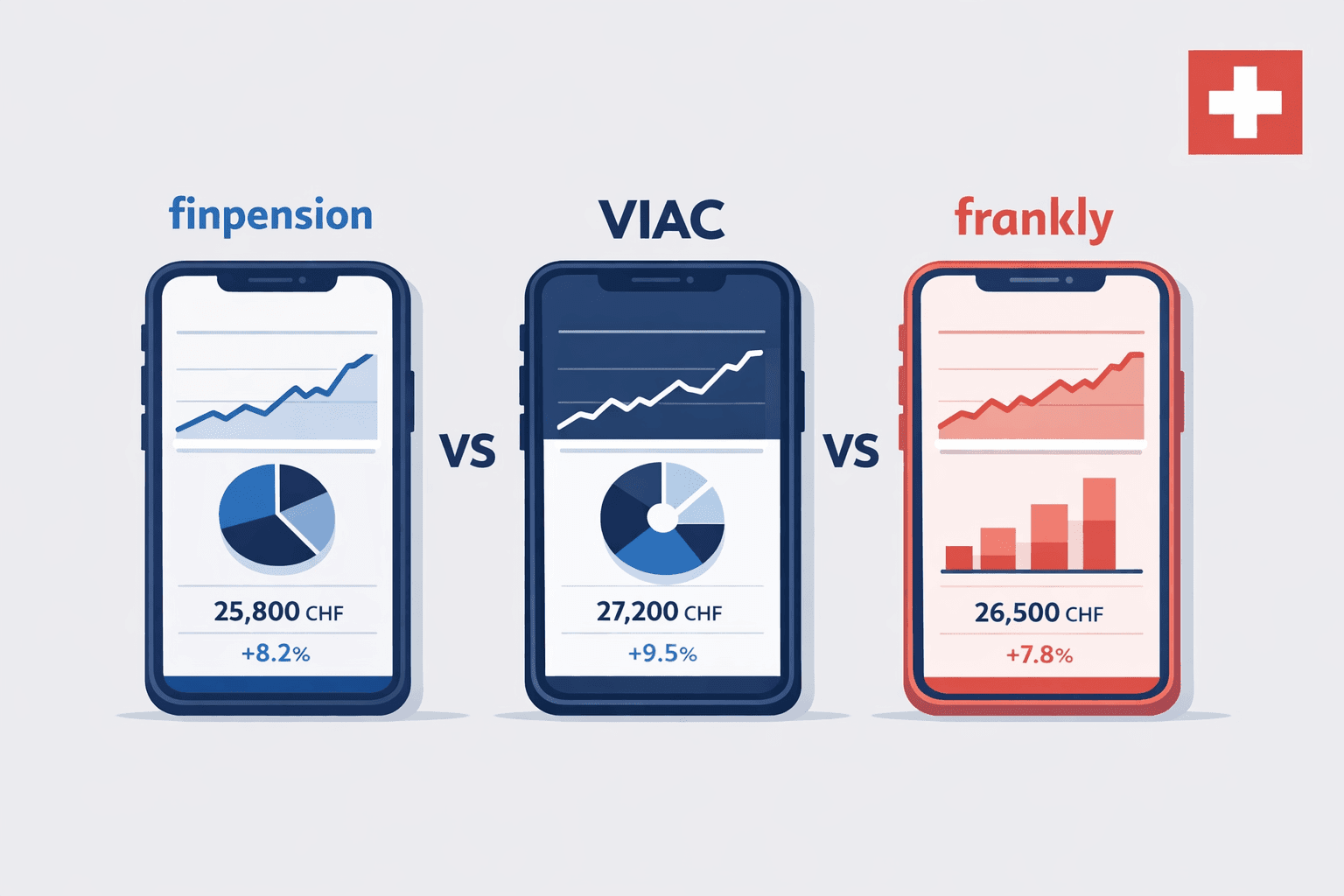
VIAC, Finpension, and Frankly control the Swiss pillar 3a app market. The fee difference between them looks small on paper (0.05 percentage points) but compounds to thousands of francs over a 30-year career. After analyzing all three side by side, the right choice depends on exactly two things: how much you want to customize, and how much you trust a big bank name.
VIAC vs Finpension vs Frankly: The Quick Verdict
All three are dramatically better than a traditional 3a savings account at your bank. But they are not the same product. Here is who wins in each category.

- All-in fee: 0.39% (flat, includes fund costs)
- FX cost: 0.00% (real-time conversion)
- Max equity: 99%
- Accounts: Up to 5
- Best for: Cost-conscious investors who want full control
- Compare on GetRates

- Management fee: 0.00% (fund costs ~0.10-0.15% extra)
- FX cost: ~0.04% per transaction
- Max equity: 99%
- Accounts: Up to 5
- Best for: App-first users who value simplicity
- Compare on GetRates

- All-in fee: 0.44% (flat, funds only)
- FX cost: Not published
- Max equity: 95%
- Accounts: Up to 2
- Best for: Risk-averse investors who want a big bank name
- Compare on GetRates
The short version: Finpension wins on fees and flexibility. VIAC wins on app experience and built-in insurance perks. Frankly is the most expensive but gives you the comfort of being backed by Zurich's cantonal bank. None is a bad choice. Picking any of these three over a traditional bank 3a is the decision that actually matters.
How Do the Fees Really Compare?
Fee structures across these three providers are designed differently, which makes a direct comparison harder than it looks.
Finpension charges a flat 0.39% all-in. This includes the management fee, fund costs, custody, and FX conversion. No hidden extras. You pay 0.39% regardless of your strategy, whether you hold 20% or 99% equities. Simple and predictable.
VIAC charges 0.00% as their product fee. But you still pay the underlying fund expense ratios, which run about 0.10% to 0.15% depending on your strategy. On top of that, VIAC charges around 0.04% on each foreign currency transaction. For a globally diversified portfolio, that adds up. The total effective cost for a typical VIAC Global 100 strategy lands somewhere around 0.40% to 0.44% when you include everything.
Frankly charges 0.44% all-in for funds. No custody fee on top. But the FX conversion cost is not published, which is a transparency gap.
The 30-Year Cost Difference in Real Francs
Assuming you contribute the maximum CHF 7,056 per year into a 100% global equity strategy:
- Finpension (0.39%): You pay roughly CHF 47 in fees in year one, scaling as your balance grows. Over 30 years with 5% average returns, total fees amount to approximately CHF 4,600.
- VIAC (~0.40-0.44%): Comparable to Finpension for high-equity strategies. Total 30-year fees around CHF 4,700 to CHF 5,200.
- Frankly (0.44% + unknown FX): The most expensive at roughly CHF 5,200 in total fees over 30 years, potentially more with FX costs.
The gap between Finpension and Frankly over 30 years is roughly CHF 600 to CHF 1,000. Meaningful, but not life-changing. The gap between any of these three and a traditional bank 3a savings account earning 0.20%? That is tens of thousands of francs in foregone returns.
Which Investment Strategies Are Available?
This is where the three providers diverge most clearly. The investment strategy options determine your long-term returns more than fee differences do.
Finpension gives you the most control. You can customize your fund allocation down to individual index funds. You choose between global, Swiss, emerging markets, real estate, and bonds in whatever proportions you want. Finpension also invests through institutional funds rather than ETFs, which gives them an advantage on withholding tax reclaims. This is worth roughly 0.10% to 0.15% per year in additional returns on foreign equities.
VIAC offers curated strategies that are well-designed. Choose from Global 20, 40, 60, 80, or 100 plus sustainable variants. You can customize within limits, but the base strategies are solid out of the box. VIAC also uses tax-optimized institutional funds, putting them on par with Finpension for tax efficiency. Where VIAC falls short: less freedom to build a truly custom allocation.
Frankly keeps it simple. You pick from Gentle (20%), Moderate (40%), Strong (60%), or Extreme (80%), plus responsible ESG alternatives. Maximum equity allocation caps at 95%, not 99%. Customization is limited. The strategies are built on ZKB's Swisscanto fund range, which means solid Swiss fund management but less flexibility than the other two.
How Safe Is Your Money?
This is the question that comes up most in Swiss forums. All three providers are supervised by FINMA, but the underlying structures differ.
VIAC operates through the Terzo Vorsorgestiftung of WIR Bank. Your money sits in a pension foundation, which is legally separated from WIR Bank itself. Even if WIR Bank went bankrupt, your 3a assets are protected. The foundation is supervised by the BVG Oberaufsichtskommission.
Finpension is a FINMA-regulated financial services company (Wertpapierhaus). Cash deposits up to CHF 100,000 are covered by the Swiss deposit protection scheme (esisuisse), identical to bank deposits. Your invested assets are held in segregated custody, meaning they remain yours even if Finpension ceased operations.
Frankly is backed by Zurich Cantonal Bank (ZKB), which carries a AAA credit rating and a state guarantee from the Canton of Zurich. This is the strongest institutional backing of the three. Your assets are held in the frankly Foundation, legally separated from ZKB.
Bottom line: All three are safe. Your invested assets (funds) are segregated and protected in all cases. The risk of losing your pillar 3a money is essentially zero with any of these providers. If institutional backing is your top concern, Frankly with ZKB's state guarantee has a slight edge, but it is not worth paying 0.05% more per year for.
How Do the Apps Compare?
All three are mobile-first apps available on iOS and Android. The experience differs more than you might expect.
VIAC has the most polished app. The interface is clean, onboarding takes about 8 minutes, and the portfolio overview is intuitive. VIAC also offers a unique perk: free disability and death insurance coverage (25% of your 3a balance) at no extra cost. The app experience is the main reason many users choose VIAC over technically cheaper alternatives.
Finpension has a functional, data-focused app. Less visually polished than VIAC, but more powerful. You get detailed breakdowns of fund allocation, cost transparency, and the ability to customize your strategy in granular detail. Finpension also offers up to 5 separate accounts, which is critical for tax-optimized staggered withdrawals.
Frankly has a clean, simple app that reflects ZKB's brand. It is the least feature-rich of the three but perfectly adequate for most users. The biggest limitation: you can only open up to 2 accounts, which severely limits your tax optimization options at retirement.
The Tax Optimization Problem With Frankly
Swiss tax law lets you reduce your tax burden at retirement by withdrawing from multiple 3a accounts in different years. The more accounts you have, the more you can spread withdrawals across tax years. VIAC and Finpension both allow 5 accounts each. Frankly limits you to 2. Over a career, this limitation could cost you thousands of francs in avoidable taxes depending on your canton.
Choose VIAC, Finpension, or Frankly?
Choose Finpension If...
You want the lowest possible costs and maximum control.
Finpension is the right choice if you want to customize your fund allocation, benefit from 0.00% FX conversion costs, and pay a transparent flat fee of 0.39%. You also get up to 5 accounts for tax optimization and institutional fund access for withholding tax reclaims.
Ideal profile: You are comfortable making your own investment decisions, you compare providers before committing, and you want every basis point of return working for you. You have more than 15 years until retirement.
Choose VIAC If...
You want a great app with solid strategies and built-in insurance.
VIAC is the right choice if you value user experience, want well-designed default strategies, and appreciate the free disability/death coverage. The fee structure is competitive (though slightly less transparent than Finpension's flat rate), and you get up to 5 accounts.
Ideal profile: You want a "set it and forget it" approach with a polished app experience. You do not need to customize every fund in your portfolio. You like the insurance safety net.
Choose Frankly If...
You want the backing of a major Swiss bank.
Frankly is the right choice if institutional trust matters more to you than saving 0.05% in fees. ZKB's AAA rating and cantonal guarantee provide the strongest safety net. The strategies are solid even if less customizable.
Ideal profile: You are more risk-averse, you trust established Swiss banking institutions, and you prefer simplicity over optimization. The 2-account limit does not bother you because you are not focused on advanced tax strategies.
You want the lowest possible costs and maximum control.
Finpension is the right choice if you want to customize your fund allocation, benefit from 0.00% FX conversion costs, and pay a transparent flat fee of 0.39%. You also get up to 5 accounts for tax optimization and institutional fund access for withholding tax reclaims.
Ideal profile: You are comfortable making your own investment decisions, you compare providers before committing, and you want every basis point of return working for you. You have more than 15 years until retirement.
You want a great app with solid strategies and built-in insurance.
VIAC is the right choice if you value user experience, want well-designed default strategies, and appreciate the free disability/death coverage. The fee structure is competitive (though slightly less transparent than Finpension's flat rate), and you get up to 5 accounts.
Ideal profile: You want a "set it and forget it" approach with a polished app experience. You do not need to customize every fund in your portfolio. You like the insurance safety net.
You want the backing of a major Swiss bank.
Frankly is the right choice if institutional trust matters more to you than saving 0.05% in fees. ZKB's AAA rating and cantonal guarantee provide the strongest safety net. The strategies are solid even if less customizable.
Ideal profile: You are more risk-averse, you trust established Swiss banking institutions, and you prefer simplicity over optimization. The 2-account limit does not bother you because you are not focused on advanced tax strategies.
Expert Recommendation
After building GetRates and analyzing every pillar 3a provider in Switzerland, here is my honest take: Finpension is the best choice for most people who are reading a comparison article like this. Why? Because if you are comparing providers, you are already an optimizer. You care about fees, returns, and making smart financial decisions. Finpension rewards that mindset with the lowest costs, the most flexibility, and excellent tax efficiency.
VIAC is a very close second, and I would not argue with anyone who picks it for the app experience or insurance coverage. The fee difference is small enough that convenience matters.
Frankly is the weakest of the three for optimizers. The higher fees, limited account count, and lower maximum equity allocation make it hard to justify unless ZKB's brand name genuinely helps you sleep at night. That said, it is still dramatically better than a 3a savings account at your local bank.
My actual setup: I split my 3a contributions across multiple providers to maximize tax optimization at withdrawal. If you are years from retirement, this is the single most impactful decision you can make after choosing to invest rather than save.

Common Mistakes When Comparing 3a Providers
VIAC advertises 0.00% fees, but the underlying fund costs and FX spreads still apply. Finpension's 0.39% is truly all-in. Always compare the total cost of ownership, not just the management fee.
If your strategy has 60% or more in foreign equities (and it should, for diversification), the FX spread matters. Finpension's 0.00% real-time FX versus VIAC's ~0.04% and Frankly's undisclosed rate creates a meaningful gap over decades.
Swiss tax law rewards staggered withdrawals from multiple accounts. Open multiple accounts with your chosen provider (up to 5 with VIAC or Finpension) from the start. Switching later is possible but loses you compounding time.
The comfort premium of ZKB's backing costs 0.05% more per year than Finpension. Over 30 years, that is CHF 600 to CHF 1,000 in extra fees. Your 3a assets are legally protected regardless of the provider. The bank name does not make your money safer.
The biggest mistake is not comparing these three at all. Any of VIAC, Finpension, or Frankly will dramatically outperform a savings account earning 0.20% interest. If you have more than 10 years until retirement, switching to an investment-based 3a is the most impactful financial decision you can make. Find the best 3a for you.
Frequently Asked Questions
Is Finpension or VIAC cheaper for pillar 3a?
Finpension charges a flat 0.39% all-in fee that includes fund costs and FX conversion. VIAC charges 0.00% as a management fee, but underlying fund costs of 0.10% to 0.15% and FX spreads of ~0.04% apply on top. For a typical global equity strategy, the total cost is comparable, with Finpension being slightly cheaper and more transparent.
Is Frankly worth it compared to VIAC and Finpension?
Frankly is a solid product backed by ZKB, but it is the most expensive of the three at 0.44% all-in. It also limits you to 2 accounts (versus 5 for VIAC and Finpension) and caps equity at 95% (versus 99%). Unless ZKB's institutional backing is a dealbreaker for you, Finpension or VIAC offer better value.
Which bank is behind VIAC?
VIAC operates through the Terzo Vorsorgestiftung of WIR Bank. Your 3a assets are held in a pension foundation that is legally separated from the bank. The foundation is supervised by the BVG oversight commission, and your investments are segregated even if WIR Bank faced financial difficulties.
Can I switch from VIAC to Finpension or vice versa?
Yes, switching between any 3a providers is straightforward and free in most cases. You open a new account with the target provider, fill out a transfer form, and the process takes 2 to 4 weeks. Your investments will be liquidated and re-invested, so there may be a brief period out of the market.
How many pillar 3a accounts should I open?
Most financial advisors recommend opening multiple accounts (3 to 5) for tax-optimized staggered withdrawals at retirement. Both VIAC and Finpension allow up to 5 accounts each. Frankly limits you to 2. Start with at least 2 to 3 accounts early in your career and contribute the maximum CHF 7,056 per year split across them.
Are VIAC, Finpension, and Frankly safe?
All three are supervised by FINMA and hold your invested assets in segregated custody. Cash deposits up to CHF 100,000 are protected by the Swiss deposit guarantee (esisuisse). Your 3a investments remain legally yours even if the provider goes bankrupt. Frankly has the additional backing of ZKB's cantonal guarantee, but all three meet the same regulatory safety standards.