

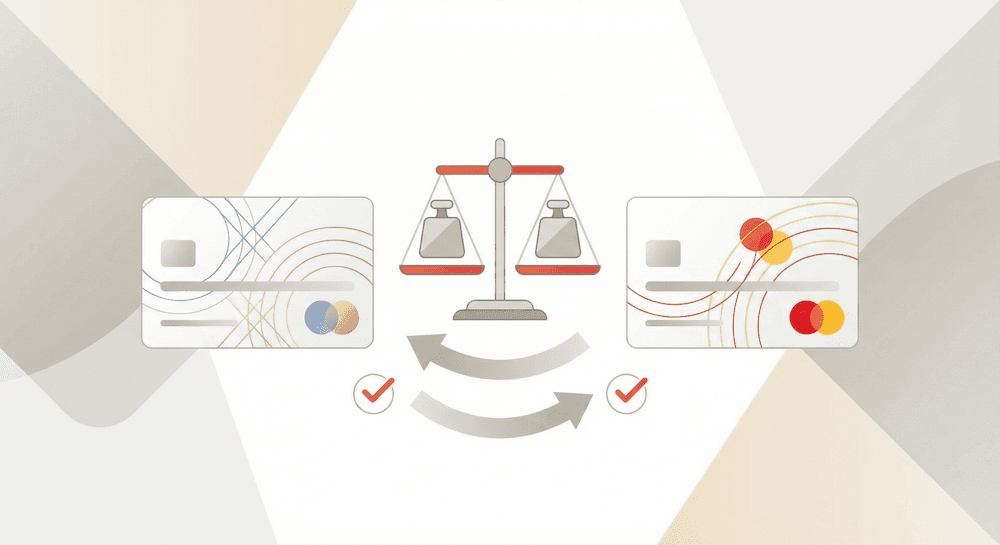
Here's the honest truth about Visa vs Mastercard in Switzerland: for 99% of your purchases, it makes zero difference. Both networks are accepted at virtually every Swiss terminal, both offer similar fraud protection, and both work worldwide. But that remaining 1% is where things get interesting, and where picking the right network can save you real money.
Visa vs Mastercard: What's the Actual Difference?
Visa and Mastercard are payment networks, not card issuers. This is the single most misunderstood thing about credit cards. Neither Visa nor Mastercard sets your annual fee, decides your credit limit, or determines your cashback rate. Your bank or issuer does that, whether it's Swisscard, Cornèrcard, Cembra, UBS, or Migros Bank.
Think of Visa and Mastercard as the highways your payment travels on. The car (your actual card, with its fees and rewards) is built by the issuer. So when someone asks "is Visa or Mastercard better?", the real answer is: the issuer and card product matter far more than the network logo.
That said, the two networks do differ in some meaningful ways for Swiss consumers. Exchange rates, card tier benefits, and niche acceptance situations create real, if small, differences. Here's exactly where those differences show up.
Are Visa and Mastercard Equally Accepted in Switzerland?
Yes, effectively. Both Visa and Mastercard are accepted at over 99% of Swiss merchants that take credit cards. The SIX payment infrastructure that powers most Swiss card terminals handles both networks identically. Walk into any Coop, Migros, Manor, or restaurant with a card terminal, and both Visa and Mastercard will work without issue.
Where you'll notice tiny differences is at the margins. Some very small, independent merchants in rural areas might only accept one network (usually the one their bank issued them a terminal for). But this is increasingly rare as modern terminals are network-agnostic.
Internationally, the picture is similar. Visa claims over 100 million merchant locations worldwide. Mastercard claims roughly 90 million. In practice, wherever one is accepted, the other almost certainly is too. The only regions where you might notice a difference are parts of Southeast Asia and Latin America, where Visa has a slightly stronger presence, and parts of Europe where Mastercard occasionally has better coverage.
For Switzerland specifically, the practical acceptance difference between Visa and Mastercard is essentially zero. If a shop takes cards, it takes both.
Visa vs Mastercard Exchange Rates: Does It Matter?
This is where things get genuinely interesting. Visa and Mastercard each set their own daily exchange rates for currency conversions, and these rates differ slightly.
Historically, Mastercard's exchange rates have been marginally better for most major currency pairs (CHF to EUR, CHF to USD, CHF to GBP). The difference is typically 0.05% to 0.15%, which sounds trivial but adds up. On CHF 10,000 of annual foreign currency spending, a 0.1% rate advantage saves you CHF 10. Not life-changing, but not nothing either.
Here's the catch though: the exchange rate matters far less than the issuer's foreign currency fee. A Visa card with 0% foreign currency processing fee will always beat a Mastercard with 1.75% processing fee, regardless of any tiny exchange rate advantage. The issuer's fee is typically 10 to 20 times larger than the network rate difference.
Both networks publish their exchange rates online. You can check Visa's rates at visa.com/support/consumer/travel-support/exchange-rate-calculator.html and Mastercard's at mastercard.com/global/en/personal/get-support/convert-currency.html. Compare them before a big trip if you're optimizing every franc.
Which Swiss Credit Cards Use Which Network?
In Switzerland, most major issuers offer both Visa and Mastercard products, sometimes even bundling both in a single package. Here's the real landscape.
Visa Cards in Switzerland
Visa is the more common network on Swiss credit cards. Major Visa products include:
- Migros Cumulus Visa (Migros Bank): Free card, no FX processing fee, earns Cumulus points
- Swisscard Cashback Visa: Free card, 0.25% cashback, part of the dual Amex/Visa package
- Viseca Visa (various banks): Available in Classic, Silver, Gold, and Platinum tiers through UBS, Raiffeisen, and cantonal banks
- Cornèrcard Visa: Available in Classic through Platinum, with Miles & More options
Visa also dominates the debit card space in Switzerland, with most banks now issuing Visa Debit cards to replace the old V-Pay system.
Mastercard Cards in Switzerland
Mastercard has strong Swiss representation, particularly in the free and cashback segments:
- Cembra Certo! One Mastercard: Free card, popular among cost-conscious consumers
- Viseca Mastercard (various banks): Available in Silver, Gold, and Platinum tiers
- Cornèrcard Mastercard: Full tier range, Miles & More packages available
- TCS Member Mastercard: Free for TCS members, decent travel benefits
- N26 Mastercard: Neobank option, competitive FX rates
Mastercard also powers many Swiss debit cards, with banks issuing Debit Mastercard alongside or instead of the retired Maestro system.
Visa is the more common network on Swiss credit cards. Major Visa products include:
- Migros Cumulus Visa (Migros Bank): Free card, no FX processing fee, earns Cumulus points
- Swisscard Cashback Visa: Free card, 0.25% cashback, part of the dual Amex/Visa package
- Viseca Visa (various banks): Available in Classic, Silver, Gold, and Platinum tiers through UBS, Raiffeisen, and cantonal banks
- Cornèrcard Visa: Available in Classic through Platinum, with Miles & More options
Visa also dominates the debit card space in Switzerland, with most banks now issuing Visa Debit cards to replace the old V-Pay system.
Mastercard has strong Swiss representation, particularly in the free and cashback segments:
- Cembra Certo! One Mastercard: Free card, popular among cost-conscious consumers
- Viseca Mastercard (various banks): Available in Silver, Gold, and Platinum tiers
- Cornèrcard Mastercard: Full tier range, Miles & More packages available
- TCS Member Mastercard: Free for TCS members, decent travel benefits
- N26 Mastercard: Neobank option, competitive FX rates
Mastercard also powers many Swiss debit cards, with banks issuing Debit Mastercard alongside or instead of the retired Maestro system.
The key takeaway: your choice of issuer and card product determines your experience far more than the network. A free Cembra Mastercard and a free Swisscard Visa will have different fees, different rewards, and different insurance, but both networks will work identically at checkout.
Card Tier Comparison: Visa vs Mastercard Benefits
Both Visa and Mastercard offer tiered benefit packages that come bundled with cards at different levels. These network-level benefits are on top of whatever the issuer includes.
Visa tiers: Classic, Gold, Platinum, Infinite Mastercard tiers: Standard, Gold, Platinum, World, World Elite
At the Classic/Standard level, the network-provided benefits are minimal for both. Basic purchase protection and zero-liability fraud coverage. Nothing to write home about.
At the Gold level, both networks add travel insurance components, extended warranty on purchases, and some concierge-style services. The specifics vary by region, but in Switzerland, the issuer's own benefits package usually overshadows the network's included benefits.
At the Platinum level and above, meaningful differences emerge. Visa Platinum includes airport lounge access through LoungeKey, while Mastercard World and World Elite cards offer access through their own lounge program. The coverage and number of included visits differ, but both provide real value for frequent travelers.
The honest assessment: for most Swiss cardholders, the tier benefits from Visa vs Mastercard are functionally identical. The issuer's benefits package (insurance coverage levels, cashback rates, annual fee) matters 10x more than the network tier.
Should I Get Visa or Mastercard for Travel?
For travel from Switzerland, both networks work equally well in the vast majority of destinations. But here are the edge cases where your choice might matter.
Visa has a slight edge in: The United States (marginally wider acceptance at smaller merchants), parts of Southeast Asia, and online merchants that only accept one network (Visa is slightly more common).
Mastercard has a slight edge in: Parts of continental Europe (some local payment schemes integrate better with Mastercard), and Costco stores worldwide (Costco exclusively accepts Mastercard for credit cards in many countries).
Neither has a meaningful edge in: Western Europe, UK, Japan, Australia, Canada, or any major tourist destination. Both work everywhere that matters.
The smart travel strategy that Moneyland.ch and most Swiss financial advisors recommend: carry one Visa and one Mastercard. If your primary card is a Visa, get a backup Mastercard (or vice versa). This way, you're covered for the rare situation where only one network is accepted, and you have a backup if one card gets blocked or stolen.
Visa or Mastercard for Online Shopping in Switzerland?
For online shopping, the network difference is even smaller than in-store. Every major Swiss and international online retailer accepts both Visa and Mastercard. Digitec, Galaxus, Zalando, Amazon, booking sites, streaming services: all accept both.
Both networks support 3D Secure authentication (Visa calls it "Visa Secure," Mastercard calls it "Mastercard Identity Check"). Both work with Apple Pay, Google Pay, and Samsung Pay in Switzerland. Both support contactless payments via NFC.
The one area where network choice might matter online is subscription services. Some international services default to one network, and in rare cases, a specific card might be declined due to the bank's fraud detection rather than the network. Having cards on both networks gives you a fallback.
Common Mistakes When Choosing Between Visa and Mastercard
The network (Visa or Mastercard) determines about 5% of your card experience. The issuer, annual fee, FX rate, cashback percentage, and insurance package determine the other 95%. A CHF 0 Mastercard with 1% cashback beats a CHF 200 Visa with 0.25% cashback every time. Compare cards, not networks.
Both Visa and Mastercard offer cards from free to ultra-premium. A Visa Classic and a Mastercard Standard are comparable. A Visa Infinite and a Mastercard World Elite are comparable. The tier is set by the issuer, not inherent to the network.
Visa and Mastercard set different exchange rates daily. The difference is small (0.05% to 0.15% typically), but it exists. If you're a heavy foreign currency spender, check which network gives better rates for your most-used currency pairs. But don't ignore the issuer's FX fee, which is 10x more impactful.
Relying on a single network abroad is an unnecessary risk. If your card gets declined, stolen, or frozen by fraud detection, having a backup on a different network can save your trip. The cost of a second free card is zero. The peace of mind is significant.
My Recommendation: Visa or Mastercard in Switzerland?
After analyzing every Swiss credit card's fee structure, benefits, and real-world acceptance, here's my honest take: it doesn't matter nearly as much as you think. The Visa vs Mastercard debate is the least important factor in choosing a credit card in Switzerland. Your annual fee, foreign currency charges, and cashback rate will affect your wallet 20x more than which network logo is on the card.
That said, if you're optimizing: carry one of each. Get your primary card on whichever network offers the best product for your needs (check our best credit cards comparison to find it), and pick up a free card on the other network as a backup. I personally use a Visa as my primary and a Mastercard as my backup. Not because Visa is "better," but because the specific Visa product I use has lower fees for my spending pattern.
Stop worrying about the logo. Start comparing the actual card products. That's where the real savings are.

Frequently Asked Questions
Is Visa or Mastercard better in Switzerland?
Neither is objectively better for Swiss consumers. Both networks are accepted at over 99% of Swiss merchants, both work worldwide, and both offer similar security features. The card issuer (Swisscard, Cembra, Cornèrcard, etc.) and specific product matter far more than the network. Choose based on fees, rewards, and insurance, not the logo.
Should I get Visa or Mastercard for traveling abroad?
For most destinations, both work identically. Visa has marginally wider acceptance in the US and parts of Asia, while Mastercard is required at Costco stores in many countries. The safest strategy is carrying one card on each network. If you only want one, Visa has a slight statistical edge in global acceptance, but the difference is minimal.
Are Visa and Mastercard exchange rates the same?
No. Each network sets its own daily exchange rates for currency conversions. Mastercard's rates have historically been marginally better for major currency pairs (by about 0.05% to 0.15%). However, the issuer's foreign currency processing fee (1.2% to 2.5% on most Swiss cards) dwarfs this difference. Focus on the fee, not the exchange rate.
Do all Swiss shops accept both Visa and Mastercard?
Virtually all Swiss merchants that accept credit cards accept both Visa and Mastercard. The SIX payment infrastructure that powers most Swiss terminals handles both networks identically. Rare exceptions exist at very small, rural merchants, but this is increasingly uncommon. American Express has significantly lower acceptance in Switzerland compared to both Visa and Mastercard.
Can I have both a Visa and a Mastercard in Switzerland?
Yes, and it's recommended. Many Swiss consumers carry one card on each network for redundancy. Several free cards are available on both networks (Cembra Certo! One on Mastercard, Swisscard Cashback on Visa). Having both costs nothing if you choose free cards and gives you a backup for travel or technical issues. Check our credit card reviews to compare specific products.