

Swiss credit card cashback rates range from 0.25% to 1.5%. On CHF 20,000 of annual spending, that's somewhere between CHF 50 and CHF 300 flowing back into your pocket. But only if you pick the right card and actually understand how the system works.
How Does Cashback Work on a Credit Card?
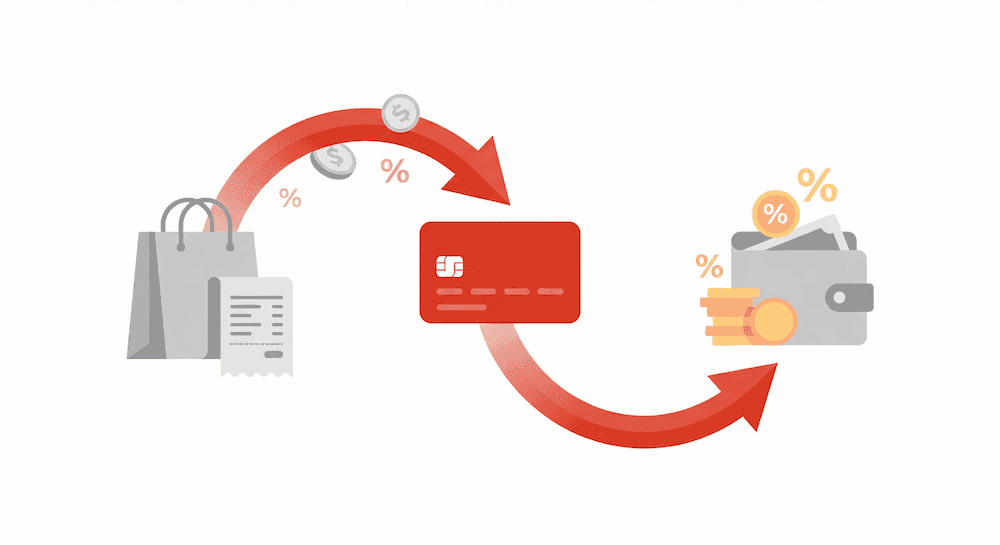
Cashback is the simplest rewards system in credit cards. Every time you pay with a cashback credit card, you get a small percentage of that purchase amount back. No points to track, no miles to redeem, no partner catalogs to browse. Just money back.
Here's the basic flow: you buy groceries for CHF 100, your card has a 1% cashback rate, you get CHF 1 credited to your account. That's it. Do this across all your spending for a year, and it adds up.
Swiss cashback cards are almost always charge cards, meaning you pay the full balance every month. This is actually a good thing. You don't carry debt, you don't pay interest, and you can ignore the interest rate entirely. Focus on the cashback rate, the annual fee, and the foreign transaction costs.
Most Swiss cards offer flat-rate cashback on all purchases. Unlike the US market with its rotating bonus categories, Switzerland keeps things straightforward. You get the same percentage whether you're buying coffee or booking a hotel. Some cards do offer higher rates at specific retailers or with Amex, but the base rate applies everywhere.
Where Does the Cashback Money Come From?
This is the question nobody asks but everyone should. Cashback isn't free money falling from the sky. It comes from the fees merchants pay every time you use your card.
When you tap your Visa or Mastercard, the merchant pays a processing fee, typically 0.4% to 1.2% depending on the card type and the deal. For American Express, merchants pay significantly more, often 2% or higher. That's why Amex acceptance in Switzerland is spottier than Visa or Mastercard.
The card issuer takes a cut of these merchant fees and shares a portion with you as cashback. So when Swisscard gives you 1% back on Amex purchases, they're paying you from the roughly 2% to 3% they collect from the merchant. It's a business model, not charity.
This is why Amex cards often have higher cashback rates. They charge merchants more, so they can afford to share more with you. The trade-off is that fewer shops accept Amex, about 70% of Swiss retailers take it compared to nearly 100% for Visa and Mastercard.
How Much Cashback Can You Realistically Earn?
Let's get specific with real Swiss numbers. Forget the marketing claims and look at what you'll actually take home.
Light Spender
At this spending level, you're looking at CHF 25 to CHF 100 in annual cashback depending on your card's rate. A free card with 0.25% gives you CHF 25. A free card with 1% Amex gives you up to CHF 100, but only if you can use Amex for most purchases.
Bottom line: stick with a free card. Any card with an annual fee will eat your cashback at this level.
Average Spender
Now the math gets interesting. On CHF 20,000 of spending, a 0.5% card gives you CHF 100, and a 1% card gives you CHF 200. If you're paying CHF 100 in annual fees, the 0.5% card breaks even while the 1% card nets you CHF 100.
Bottom line: mid-tier cards with 0.5% to 0.75% cashback and moderate fees work well here. Check if the included insurance saves you money elsewhere.
High Spender
This is where premium cashback cards justify their fees. On CHF 30,000 of spending, a 1% card gives you CHF 300. Even after a CHF 150 annual fee, you're netting CHF 150 plus whatever insurance and perks come with the card.
Bottom line: premium cards from Swisscard, Cornèrcard, or PostFinance deliver real value at this level. Compare them in our best cashback credit cards guide.
At this spending level, you're looking at CHF 25 to CHF 100 in annual cashback depending on your card's rate. A free card with 0.25% gives you CHF 25. A free card with 1% Amex gives you up to CHF 100, but only if you can use Amex for most purchases.
Bottom line: stick with a free card. Any card with an annual fee will eat your cashback at this level.
Now the math gets interesting. On CHF 20,000 of spending, a 0.5% card gives you CHF 100, and a 1% card gives you CHF 200. If you're paying CHF 100 in annual fees, the 0.5% card breaks even while the 1% card nets you CHF 100.
Bottom line: mid-tier cards with 0.5% to 0.75% cashback and moderate fees work well here. Check if the included insurance saves you money elsewhere.
This is where premium cashback cards justify their fees. On CHF 30,000 of spending, a 1% card gives you CHF 300. Even after a CHF 150 annual fee, you're netting CHF 150 plus whatever insurance and perks come with the card.
Bottom line: premium cards from Swisscard, Cornèrcard, or PostFinance deliver real value at this level. Compare them in our best cashback credit cards guide.
The average Swiss household puts about CHF 15,000 to CHF 25,000 on credit cards per year. At the midpoint of CHF 20,000 with a 0.5% card, you're earning CHF 100 annually. Not life-changing, but not nothing either.
How Do You Get Your Cashback Paid Out?
The payout process varies by card issuer, and this is where some cards quietly disappoint you.
Automatic annual payout is the most common method in Switzerland. Cards from Swisscard and PostFinance typically credit your cashback once a year as a statement credit on your card account. You don't need to do anything. The money just appears, usually in January or February for the previous year's spending.
Manual redemption is the approach Cornèrcard uses. You need to log into their customer portal and actively request your cashback. This adds friction, and plenty of people forget to do it. Cornèrcard also has a minimum threshold of CHF 25 before you can redeem, and your cashback expires after one year from the transaction date.
Quarterly or monthly payouts are less common but some digital banks and newer providers offer them. Getting your cashback more frequently is obviously better, since you can put that money to work sooner.
Is a Cashback Credit Card Worth It?
Honest answer: it depends on exactly one thing. Can the cashback you earn beat the annual fee you pay?
Here's the break-even math for common Swiss cards:
- Free card at 0.25%: always worth it. You can't lose money.
- CHF 50 fee at 0.5%: break-even at CHF 10,000 annual spending
- CHF 100 fee at 0.75%: break-even at CHF 13,333 annual spending
- CHF 150 fee at 1%: break-even at CHF 15,000 annual spending
If your spending is below the break-even point, you're paying the card issuer for the privilege of getting cashback. That's a bad deal.
But fees don't tell the whole story. Premium cashback cards typically include travel insurance, purchase protection, and extended warranty coverage. If you'd buy travel insurance anyway at CHF 150 per year, a premium card that includes it effectively has no fee.
My honest take: most people should start with a free cashback card. If you're spending CHF 20,000+ per year and would benefit from the included insurance, then upgrading to a premium card makes financial sense. Run the numbers with our cashback calculator to see exactly where you stand.
Cashback vs Points vs Miles: Which Reward System Wins?
This isn't really a financial question. It's a personality question.
Guaranteed value. No optimization needed. 0.25% to 1.5% back automatically. Best for people who value simplicity.
Redeemable for products, experiences, or statement credits. Requires tracking. Can deliver good value if you redeem wisely.
2x to 5x potential value on flight upgrades. Requires active management and frequent flying. Best for loyal Star Alliance flyers.
Cashback wins on simplicity and predictability. You know exactly what you're getting, and you don't need to spend hours optimizing redemptions. Travel miles can deliver 3x to 5x the value per franc spent, but only if you fly frequently and redeem strategically.
For most Swiss residents who fly fewer than four times a year, cashback is the smarter choice. If you're a frequent SWISS or Lufthansa flyer, check out travel credit cards instead.
Common Cashback Mistakes to Avoid
After years of analyzing Swiss credit card data, I see the same errors again and again.
Your 1% cashback card charges 2% on foreign transactions? That's a net loss of 1% on every international purchase. This hits hard when buying from EU online shops or traveling. Always check the foreign currency fee before you swipe abroad.
A CHF 150 annual fee with 1% cashback needs CHF 15,000 in spending just to break even. Most people overestimate their credit card spending by 30% to 40%. Check your actual statements before committing to a premium card.
Swiss credit cards charge 9% to 15% interest on unpaid balances. At those rates, your entire year of cashback gets wiped out in a single month of carried debt. Always pay your full balance every month. No exceptions.
Cards like Cornèrcard require you to manually claim your cashback through their portal. It expires after 12 months. Set a calendar reminder or switch to a card with automatic payouts.
Earning CHF 1 back on CHF 100 of unnecessary purchases means you spent CHF 99 you didn't need to. Cashback should reward spending you'd do anyway, not incentivize new spending.
Expert Recommendation
After building GetRates and analyzing every cashback card in the Swiss market, here's my honest advice: start with a free cashback card and see how your spending patterns look after six months. Most people who jump straight to premium cards end up paying more in fees than they earn back. A free card at 0.25% is guaranteed to save you money. If your statements show CHF 20,000+ in annual spending, then upgrade. But only then. The best card is the one where the math actually works for your specific situation.

Frequently Asked Questions
How much cashback can you earn with a credit card in Switzerland?
Swiss cashback rates range from 0.25% to 1.5% depending on the card. On CHF 20,000 of annual spending, you'll earn between CHF 50 and CHF 300 gross. Subtract the annual fee to get your actual return. Most Swiss households net between CHF 50 and CHF 200 per year from cashback.
Is credit card cashback taxable in Switzerland?
No. Swiss tax authorities treat cashback rewards as purchase price reductions, not taxable income. Your regular cashback earnings don't need to be declared on your tax return. This applies to all standard consumer cashback programs in Switzerland.
How does the cashback payout work on Swiss cards?
Most Swiss cards pay cashback automatically once a year as a statement credit, typically in January. Some cards like Cornèrcard require manual redemption through their online portal. Digital banks may offer quarterly or monthly payouts. Check your card's specific payout terms.
Are free cashback credit cards worth it?
Yes, always. With no annual fee, every franc of cashback is pure profit. Even a modest 0.25% rate on CHF 15,000 of spending gives you CHF 37.50 you wouldn't have otherwise. Free cards are the right choice for anyone spending under CHF 15,000 per year on credit cards.
What's better: cashback or Miles & More points?
Cashback gives you guaranteed, predictable value with zero effort. Miles & More can deliver 2x to 5x the value per franc if you redeem for flight upgrades, but it requires frequent flying and active management. If you fly fewer than four times a year, cashback is almost certainly the better choice. Check our credit card reviews for detailed comparisons.