


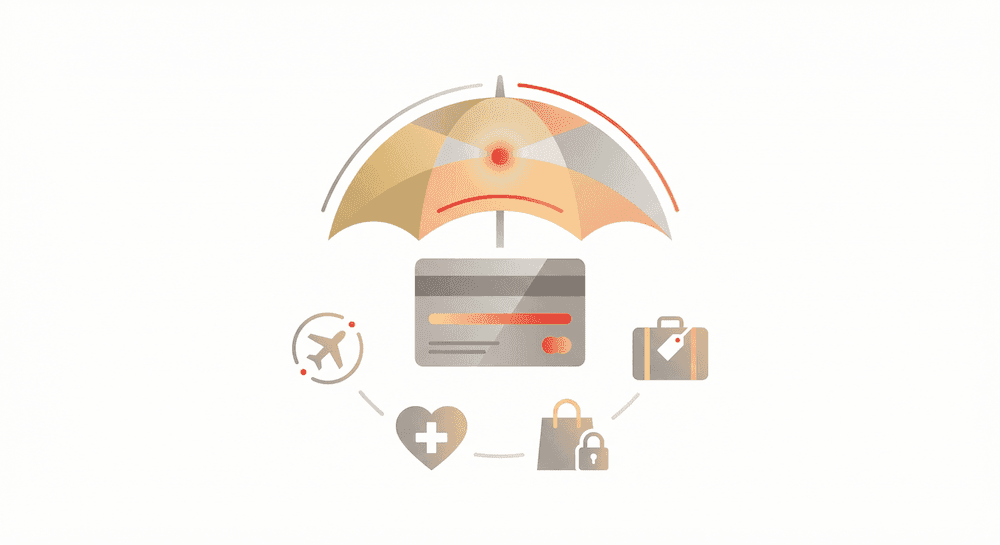
You're probably paying for credit card insurance you've never used. Or worse, you're skipping coverage you already have because nobody told you it was included. Either way, most Swiss cardholders leave money on the table when it comes to insurance benefits.
What Insurance Do Swiss Credit Cards Actually Include?
Swiss credit cards bundle several types of insurance, but the coverage varies wildly depending on your card tier. A free card might give you CHF 1,000 in purchase protection. A Platinum card could cover CHF 1,500,000 in emergency medical costs abroad. The gap is enormous. All Swiss credit card issuers are supervised by FINMA, the Swiss Financial Market Supervisory Authority, which sets the framework for consumer protection.
Here's what you need to know upfront: insurance is tied to your card tier, not the network. Visa and Mastercard don't provide insurance themselves. Your issuer (Swisscard, UBS, Cembra, Viseca) arranges the coverage. So two "Gold" cards from different issuers can have completely different insurance packages.
The most common insurance types bundled with Swiss credit cards fall into three categories: travel insurance (the big one), purchase protection (useful but limited), and niche extras like rental car coverage and legal assistance. Let's break each one down.
Travel Insurance: The Most Valuable Credit Card Benefit
Travel insurance is where credit card insurance actually becomes worth talking about. Premium Swiss credit cards include coverage that would cost CHF 200 to CHF 400 per year if purchased separately. That's real savings, not marketing fluff.
The key travel insurance benefits include emergency medical coverage abroad (up to CHF 1,500,000 on Platinum cards), trip cancellation insurance (typically CHF 5,000 to CHF 20,000), trip interruption coverage, flight delay compensation, and search and rescue costs.
The critical catch: you must pay for your entire trip with the credit card. Book your flights with one card and your hotel with another? The insurance may not cover you at all. Some issuers require 100% of the trip cost to be charged to the card. Others accept a minimum threshold (like 60% at Raiffeisen). Always check the fine print.
Emergency Medical Coverage Abroad
This is the most financially significant insurance benefit. Swiss mandatory health insurance (KVG/LAMal) covers emergencies in EU/EFTA countries at double the Swiss tariff rate, but outside Europe, especially in the US, your coverage might be dangerously inadequate. A single hospital visit in the US can easily cost CHF 50,000 or more.
Premium credit cards fill this gap. UBS Platinum cards cover up to CHF 1,000,000 in medical costs abroad. Swisscard Platinum goes even higher. Free cards like the Certo! One Mastercard offer up to CHF 100,000, which is decent but insufficient for serious medical emergencies in the US.
If you travel outside Europe more than once a year, this coverage alone can justify a premium card's annual fee. Compare that to buying standalone travel medical insurance, which runs CHF 100 to CHF 300 annually depending on your destination coverage.
Rental Car Insurance: The Overlooked Benefit
When you rent a car abroad, the rental company will push you hard to buy their collision damage waiver (CDW). That typically costs CHF 15 to CHF 30 per day. Over a two-week holiday, that's CHF 210 to CHF 420 you could save.
Many Gold and Platinum credit cards include rental car collision insurance that covers the deductible on the mandatory CDW. So you can decline the rental company's overpriced insurance and rely on your card's coverage instead.
This works particularly well in the US, where rental car insurance markups are aggressive. If you rent cars even twice a year, the savings can offset a significant portion of your card's annual fee. Check whether your card covers the full deductible or only a portion, and whether there are geographic restrictions.
Which Credit Card Has the Best Insurance?
This is the question everyone asks, and the honest answer is: it depends on what you actually need. Here's how the tiers stack up.
Free Cards
Free cards give you the basics. The Certo! One Mastercard includes purchase protection up to CHF 2,000 per event, a best-price guarantee up to CHF 3,000 per year, and travel insurance up to CHF 100,000. The Migros Cumulus Visa offers similar coverage at slightly lower amounts. Don't expect medical coverage or rental car insurance at this tier. If you travel infrequently and mostly within Europe, free card insurance is adequate.
Gold Cards
Gold cards are the sweet spot for moderate travelers. You get meaningful medical coverage abroad (typically CHF 250,000 to CHF 500,000), trip cancellation insurance, purchase protection, and often rental car CDW coverage. UBS Gold, Swisscard Gold, and the Miles & More Gold all deliver solid packages. The annual fee of CHF 100 to CHF 250 is easily justified if the travel insurance alone would cost you CHF 150 to CHF 200 separately.
Platinum Cards
Platinum cards go all out. Medical coverage up to CHF 1,500,000, comprehensive trip cancellation, flight delay compensation, rental car full coverage, legal protection, and even key loss insurance. The American Express Platinum, Swisscard Platinum, and UBS Platinum lead this tier. Worth it only if you travel frequently (4+ trips per year) and actually use the coverage. Otherwise, you're paying a premium for insurance you'll never claim.
Free cards give you the basics. The Certo! One Mastercard includes purchase protection up to CHF 2,000 per event, a best-price guarantee up to CHF 3,000 per year, and travel insurance up to CHF 100,000. The Migros Cumulus Visa offers similar coverage at slightly lower amounts. Don't expect medical coverage or rental car insurance at this tier. If you travel infrequently and mostly within Europe, free card insurance is adequate.
Gold cards are the sweet spot for moderate travelers. You get meaningful medical coverage abroad (typically CHF 250,000 to CHF 500,000), trip cancellation insurance, purchase protection, and often rental car CDW coverage. UBS Gold, Swisscard Gold, and the Miles & More Gold all deliver solid packages. The annual fee of CHF 100 to CHF 250 is easily justified if the travel insurance alone would cost you CHF 150 to CHF 200 separately.
Platinum cards go all out. Medical coverage up to CHF 1,500,000, comprehensive trip cancellation, flight delay compensation, rental car full coverage, legal protection, and even key loss insurance. The American Express Platinum, Swisscard Platinum, and UBS Platinum lead this tier. Worth it only if you travel frequently (4+ trips per year) and actually use the coverage. Otherwise, you're paying a premium for insurance you'll never claim.
Credit Card Insurance vs. Standalone Travel Insurance
Here's a question I get asked constantly: should you rely on credit card insurance or buy a separate travel policy? The answer depends on three factors.
Frequency of travel: If you travel 3+ times per year, a credit card with built-in insurance is almost always cheaper than buying separate policies each time. An annual travel insurance policy costs CHF 150 to CHF 400 in Switzerland, depending on coverage. A Gold credit card at CHF 150 to CHF 250 per year gives you both insurance and a credit card.
Destination: For Europe, your Swiss health insurance plus a free credit card's basic coverage is usually sufficient. For the US, Southeast Asia, or other high-cost medical destinations, you want the higher limits that Gold or Platinum cards provide.
The payment condition: Credit card insurance only covers trips paid with that card. If you sometimes book flights with a debit card to save on foreign exchange fees, your credit card insurance won't apply. This is the biggest trap. You have to choose between lower transaction fees (debit card) and insurance coverage (credit card).
Credit card insurance only covers purchases made with that specific card. Book a flight with your debit card and the hotel with your credit card? Your trip cancellation insurance likely won't cover the flight portion. Always pay the full trip with the insured card.
Each issuer has different rules. Some require you to file a police report within 24 hours for theft claims. Others require pre-authorization for medical treatment. Know the process before you need it, not during a crisis abroad.
If your credit card covers trip cancellation, don't buy extra cancellation insurance from the airline. If you have complementary health insurance with worldwide coverage, the medical benefit of your card is redundant. Audit all your existing policies before deciding on a card tier.
Insurance is one factor. If you pick a CHF 500/year Platinum card for the insurance but barely travel, you're overpaying. A standalone annual travel policy at CHF 200 plus a free card would save you CHF 300.
How to File a Credit Card Insurance Claim
Filing a claim is straightforward if you know the process ahead of time. Most Swiss cardholders never file a claim simply because they don't know they're covered. Here's the general process.
Before your trip, check what your card actually covers. Log in to your issuer's portal (Swisscard, UBS, Viseca) or call their hotline. Get a copy of the insurance conditions (Versicherungsbedingungen) and save it on your phone.
In case of a claim, you'll need receipts, police reports (for theft), medical records (for health claims), or airline confirmation of delays. Start documenting immediately when an incident occurs.
Your credit card issuer partners with an insurance company (often Zurich Insurance, AXA, or ERV). Contact them directly through your card issuer's claims portal or hotline. Most have a 30-day filing window.
You'll need your credit card statement showing the relevant purchase. This is the critical link that proves you paid with the insured card. Keep all statements digitally.
My Recommendation: What Insurance Strategy Actually Works
After years of comparing cards and optimizing my own setup, here's my honest take: most people are fine with a free card's basic coverage plus their existing Swiss health insurance. If you travel outside Europe more than twice a year, upgrade to a Gold card for the medical coverage alone. It pays for itself. Platinum cards only make sense if you travel frequently, rent cars abroad, and will actually use the lounge access and concierge services that come bundled with them. Don't pay CHF 500+ per year for insurance you'll claim once in a decade. For the full picture on premium credit cards in Switzerland, check our comparison. If travel is your main concern, our best travel credit cards guide breaks down the value proposition card by card.

Frequently Asked Questions
What credit card insurance do free cards include in Switzerland?
Free Swiss credit cards typically include basic purchase protection (CHF 1,000 to CHF 2,000 per event), a best-price guarantee, and limited travel insurance (CHF 60,000 to CHF 100,000). They generally don't include medical coverage abroad or rental car insurance. For domestic spending and occasional European travel, that's sufficient. For anything more, you'll need a Gold or Platinum card.
Does credit card travel insurance cover my family?
It depends on the card and issuer. Many Gold and Platinum cards extend coverage to your spouse and children traveling with you. Some cover only the cardholder and additional cardholders. Always check the "insured persons" section of your policy. If your family isn't covered, you may need separate travel insurance for them.
Can I use credit card insurance instead of buying travel insurance?
Yes, if your card's coverage matches your needs. For European travel, a Gold card's insurance is often sufficient. For destinations with high medical costs (US, Canada, Japan), verify that the coverage limits are adequate. The key limitation is the payment condition: your entire trip must be paid with the insured card to be covered.
Is credit card rental car insurance accepted by rental companies?
Rental car companies must accept your decision to decline their insurance. However, they may place a larger hold on your credit card as a deposit. Bring a printout or digital copy of your credit card's insurance terms to show the rental desk. Some companies, particularly in certain US states, may still pressure you to buy their coverage.
How do I know what insurance my credit card includes?
Check your issuer's website under "card benefits" or "insurance." Swisscard, UBS, Viseca, and Cembra all publish detailed insurance condition PDFs. You can also call the customer service number on the back of your card. For a side-by-side comparison, check our credit card reviews which include insurance breakdowns.