as a preferred source on Google
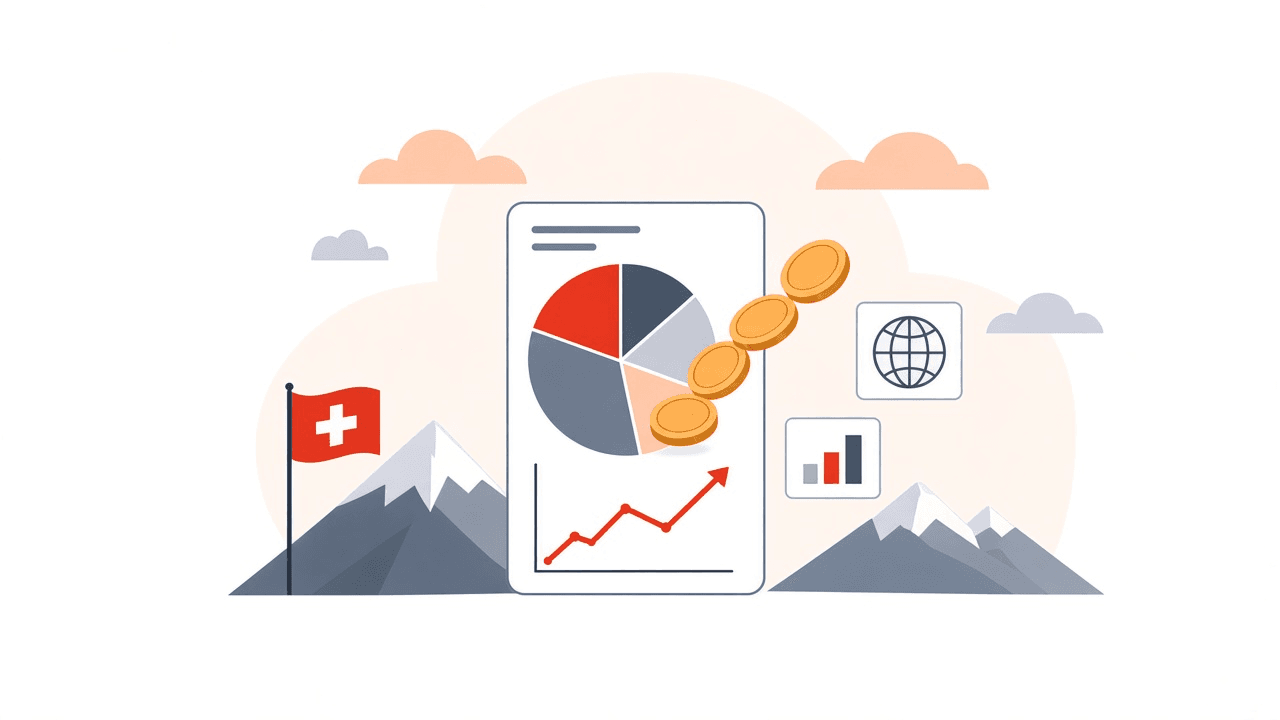
One CHF 5,000 ETF purchase costs CHF 5 at Interactive Brokers and CHF 52.50 at UBS. Same fund, same exchange, more than ten times the price. If you want to invest in ETFs, the fund you pick matters, but the broker and the trading line you buy on decide how much of your money goes to fees. This guide shows you how to buy ETFs in Switzerland step by step, what each broker charges and how to choose an ETF as a Swiss investor.
How do you buy ETFs in Switzerland?
To buy ETFs in Switzerland, you open a securities account at a Swiss bank, an investing app or a foreign broker, transfer CHF and buy the ETF by its ISIN, ideally on SIX in CHF. One CHF 5,000 purchase costs CHF 5 to 52.50 in commission and stamp duty, depending on the broker.
An ETF (exchange-traded fund) is a fund that tracks an index, such as the MSCI World or the SPI, and trades on the stock exchange like a share. Unlike a classic fund that you subscribe to through your bank, you buy and sell an ETF at the current market price, whenever the exchange is open. Most ETFs are passive, which keeps their running costs low: our guide on passive vs active funds compares the two.
How to buy an ETF in 4 steps
- Choose a broker and open a securities account. It takes one sitting online with your ID and a smartphone. The broker you choose drives your costs for years, so compare first (see the tables below).
- Transfer CHF from your bank account. A normal bank transfer is enough. As long as you buy ETFs traded in CHF, nothing is converted.
- Find the ETF by its ISIN and pick the CHF line on SIX. The ISIN is a 12-character code that identifies exactly one fund. The same ETF often trades on several exchanges and in several currencies.
- Place a limit order during SIX trading hours. Enter the amount, set a limit close to the current price, check the cost estimate and confirm.
The order ticket works the same way for an ETF as for a share. Our guide on how to buy shares in Switzerland explains each field, from the order type to fractional shares.
Where can you buy ETFs cheapest in Switzerland?
Every ETF purchase costs you the broker's commission and, at a Swiss broker, the Swiss stamp duty: 0.15% for a foreign-domiciled ETF and 0.075% for a Swiss one, charged on purchases and sales, as the federal tax administration explains in German. Foreign brokers don't charge it. If the ETF trades in USD, currency exchange comes on top.
What one CHF 5,000 ETF purchase costs at each broker
Here's one purchase of a foreign-domiciled ETF, such as a world ETF domiciled in Ireland, bought in CHF on SIX:
| Broker | Commission | Stamp duty | Total |
|---|---|---|---|
| Interactive Brokers | CHF 5.00 | None | CHF 5.00 |
| DEGIRO | CHF 6.00 | None | CHF 6.00 |
| Saxo Bank | CHF 4.00 | CHF 7.50 | CHF 11.50 |
| Cornèrtrader | CHF 9.00 | CHF 7.50 | CHF 16.50 |
| Swissquote¹ | CHF 9.85 | CHF 7.50 | CHF 17.35 |
| PostFinance E-Trading | CHF 20.00 | CHF 7.50 | CHF 27.50 |
| Yuh | CHF 25.00 | CHF 7.50 | CHF 32.50 |
| neon invest² | CHF 25.00 | CHF 7.50 | CHF 32.50 |
| UBS e-banking Trading | CHF 45.00 | CHF 7.50 | CHF 52.50 |
- ¹ Swissquote: price for ETFs in the ETF Leaders programme. Outside it, the commission is CHF 29.85 and the total CHF 37.35; exchange fees come on top.
- ² neon invest: trades on BX Swiss, not SIX.
- Trading 212: no published cost for a SIX ETF purchase.
- Yuh, neon invest: 0% commission on selected ETFs bought through a savings plan; stamp duty still applies.
- Swiss-domiciled ETF: stamp duty is 0.075%, so CHF 3.75 instead of CHF 7.50.
The ranking is clear: foreign brokers come first because they skip the stamp duty, and the big bank comes last. Click a broker to read our review, or put Interactive Brokers, Saxo and Swissquote side by side in our comparison tool. For the yearly cost with custody and FX included, see our broker comparison by investor profile.
Buying a USD-listed ETF: the FX fee can cost more than the commission
Many popular ETFs also trade in USD, on SIX or on a US exchange. If you buy that line, the broker converts your francs into dollars and keeps a margin. Here's the FX cost alone on CHF 5,000:
| Broker | FX fee | FX cost |
|---|---|---|
| Interactive Brokers¹ | 0.002% | CHF 1.60 |
| Trading 212 | 0.15% | CHF 7.50 |
| Saxo Bank | 0.25% | CHF 12.50 |
| DEGIRO | 0.25% | CHF 12.50 |
| Cornèrtrader | 0.80% | CHF 40.00 |
| Yuh | 0.95% | CHF 47.50 |
| Swissquote | 0.95% | CHF 47.50 |
| PostFinance E-Trading | 1.00% | CHF 50.00 |
- ¹ Interactive Brokers: 0.002% with a minimum of USD 2, about CHF 1.60 at USD/CHF 0.80.
- neon invest: CHF only, no USD-listed ETFs.
- UBS e-banking Trading: FX margin not published.
At several brokers, the FX fee on a single purchase is higher than the commission. The fix is simple: when the ETF has a CHF trading line on SIX, buy that one. Your money isn't converted at the broker, and you skip the FX margin entirely.
Custody fees: the yearly cost on top
Commissions are paid once, custody fees every year. Saxo, Interactive Brokers, DEGIRO, Yuh, neon and Trading 212 charge none. Cornèrtrader is free up to CHF 10,000, then from CHF 20 a quarter plus VAT. PostFinance charges CHF 72 a year and credits it back as brokerage credit each quarter. Swissquote charges CHF 86.48 to 216.20 a year, depending on your portfolio, and UBS 0.35% a year plus VAT. For a long-term ETF investor, the custody fee often costs more than all the purchases together.
Swiss or foreign broker for ETFs?
A Swiss broker charges stamp duty but sends you an eTax statement for your tax return, free at Saxo and neon. A foreign broker such as Interactive Brokers or DEGIRO is cheaper per purchase, but you list your positions yourself at tax time. If you open a Swissquote account, the Swissquote promo code gives new clients CHF 100 in trading credit when they pay in CHF 1,000 within 3 months.
Which ETF should you buy as a Swiss investor?
There's no single best ETF, but a few criteria matter more in Switzerland than elsewhere: where the fund is domiciled, which trading line you buy, and what it costs to hold.
Fund domicile: Swiss, Irish or US ETF?
The fund's domicile decides how its dividends are taxed before they reach you, and how much stamp duty you pay. Here are three widely held examples, not recommendations:
| Domicile | Example (ISIN or ticker) | TER | Withholding tax on dividends | Stamp duty at a Swiss broker |
|---|---|---|---|---|
| Switzerland | iShares Core SPI (CH0237935652) | 0.10% | 35% Swiss tax, fully reclaimable in your tax return | 0.075% |
| Ireland | Vanguard FTSE All-World (IE00B3RBWM25), iShares Core MSCI World (IE00B4L5Y983) | 0.14%, 0.20% | No Swiss tax; the fund pays US tax on US dividends that you can't reclaim | 0.15% |
| United States | Vanguard Total World (VT) | 0.06% | 15% US tax with the W-8BEN form, creditable with the DA-1 form above CHF 100 of foreign tax a year | 0.15% |
TERs as of October 2026, from justETF and issuer data. They change, so check the factsheet before you buy. US-domiciled ETFs have the lowest TERs, but they come with access limits and a US estate tax risk (see below).
Buy the CHF trading line on SIX
The same ETF can trade on SIX in CHF, in USD and in EUR, and on foreign exchanges. On your broker's order ticket, search by ISIN, then pick the line on SIX Swiss Exchange in CHF. It avoids currency exchange at the broker. Buy during SIX trading hours with a limit order rather than at the opening, when prices can jump.
Index, TER, fund size and replication
Start with the index: a world index (MSCI World, FTSE All-World, MSCI ACWI) spreads your money across more than a thousand companies, a Swiss index (SPI, SMI) keeps you in your home market. Then compare the TER, the yearly running cost deducted inside the fund. Between two ETFs on the same index, the cheaper one usually wins over 20 years.
Check the fund size too: a large ETF trades more easily and is less likely to be closed. Replication tells you whether the fund holds the actual shares (physical) or tracks the index through a swap (synthetic). Physical replication is the simpler choice for most people. A CHF-hedged version protects you against currency moves but costs more each year.
Accumulating or distributing?
A distributing ETF pays dividends into your account, an accumulating one reinvests them in the fund. For your taxes, it makes no difference: in Switzerland, both are taxed every year on the income the fund earns, and the taxable amount appears in the federal tax administration's ICTax list. Pick the one that fits your habits. Our guide to taxes on shares and ETFs in Switzerland explains how ETF income is taxed.
Which ETF is best for beginners in Switzerland?
We don't name a winner, because the right ETF depends on your goals and your other investments. For a beginner, a good ETF usually ticks these boxes: a broad world or Swiss index, a low TER, a large fund, physical replication and a CHF trading line on SIX. Funds like the Vanguard FTSE All-World, the iShares Core MSCI World or the iShares Core SPI from the table above are well-known examples that meet these criteria. Compare them on justETF or the issuer's factsheet before you decide.
Can Swiss residents buy US ETFs like VT?
Sometimes, depending on the broker. Under Swiss law (FinSA, or FIDLEG in German), a financial instrument offered to retail clients needs a key information document. Many US-domiciled ETFs don't provide one, so many brokers don't sell them to private clients. The law makes one exception: under Art. 8 para. 4 FinSA, no key information document is required when the broker only executes or transmits your order.
According to The Poor Swiss (2024 update), Interactive Brokers still lets Swiss residents buy US-domiciled ETFs, while DEGIRO stopped in 2019. Rules differ between brokers and change over time, so check with the broker before you open an account for this reason.
Before you buy, weigh the trade-off. US ETFs like VT have very low TERs and the 15% US withholding tax can be credited with the DA-1 form. But US-domiciled funds can expose your estate to US estate tax, and you'll often pay FX on every purchase. If you plan to hold large amounts, talk to a tax adviser first.
One-off purchase or ETF savings plan?
You can invest a lump sum in one purchase, or invest a fixed amount every month with a savings plan. Lump sums keep commissions low per franc invested, while savings plans make investing automatic and some apps charge no commission on selected ETFs. To see what a monthly amount could grow to over 20 years, try our ETF calculator.
How much money do you need to invest in ETFs?
Less than you think. With a savings plan, you can start from CHF 1 at neon, PostFinance or Trading 212, or CHF 10 at Yuh. The real limit is the commission: a CHF 5 commission at Interactive Brokers is 0.5% of a CHF 1,000 order, and fixed fees at a big bank weigh even more on small amounts. Saxo charges a percentage with a CHF 3 minimum, which suits smaller orders.
As a rule of thumb, invest money you won't need for at least five years, and keep a cash cushion in a savings account. Before you open a taxable broker account, check your third pillar: investing in pillar 3a funds gives you a tax deduction no broker can match. Our guide to investing in pillar 3a funds explains how to start.
Common mistakes when buying ETFs
The same ETF often has USD and EUR lines next to the CHF one. If it trades in CHF on SIX, buy that line and skip the FX margin.
A big bank charges a high commission per purchase and a custody fee every year. Over 20 years, that can cost more than the ETF's own fees.
Last year's winner is often a narrow sector or country fund. Choose on index, TER, size and trading line, not on recent performance.
Prices can jump in the first minutes of trading. Use a limit order close to the current price, during SIX trading hours.
Reinvested income is still taxable every year in Switzerland. The amount appears in the ICTax list and on your eTax statement.
US-domiciled funds can expose your estate to US estate tax. Check this with a tax adviser before you invest large amounts.
My take
If a friend asked me how to buy ETFs in Switzerland, I'd keep it boring. Fill your pillar 3a first. Then pick one world ETF as your core and buy it in CHF on SIX at a low-cost broker, not at your house bank. Interactive Brokers makes sense for large amounts or if you want US ETFs and don't mind doing your own tax list. Saxo is the easy choice if you want a Swiss bank and a free eTax statement. After that, add money regularly and stop checking the price every day.

Frequently asked questions
Where can I buy ETFs cheapest in Switzerland?
Foreign brokers like Interactive Brokers and DEGIRO are the cheapest for one ETF purchase on SIX, because they don't charge Swiss stamp duty. Among Swiss brokers, Saxo costs the least in our table. Big banks like UBS cost several times more per purchase and add a custody fee every year.
Which broker is best for ETFs in Switzerland?
It depends on how you invest. Interactive Brokers is the cheapest for large amounts and still offered US ETFs to Swiss residents in 2024, but you do your own tax list. Saxo is the cheapest Swiss bank with a free eTax statement. Yuh and neon are the simplest apps for small monthly amounts. Our broker comparison ranks 10 brokers on real yearly costs.
Which ETF is best for beginners in Switzerland?
There's no single best ETF. Look for a broad world or Swiss index, a low TER, a large fund, physical replication and a CHF trading line on SIX. Well-known examples are the Vanguard FTSE All-World, the iShares Core MSCI World and the iShares Core SPI. Check the current factsheet before you buy.
Can Swiss residents buy US ETFs like VT?
At some brokers. Swiss law requires a key information document for products offered to retail clients, which many US ETFs don't have, but not for pure execution-only orders. Interactive Brokers still allowed it in 2024, DEGIRO stopped in 2019. Check with your broker, and keep the US estate tax risk in mind.
Should I buy ETFs in CHF or USD?
In CHF, whenever the ETF has a CHF trading line on SIX. The fund still invests worldwide, so you keep the same exposure, but you don't pay the broker's FX margin. At some brokers, that margin is close to 1% of the amount, which is more than the commission.
Accumulating or distributing: which should I choose?
For your taxes, it doesn't matter: in Switzerland, both are taxed every year on the fund's income, with the amount listed in the ICTax list. Accumulating ETFs reinvest for you, distributing ones pay cash that you reinvest or spend. Choose what fits your habits.
Do I pay stamp duty on ETFs?
Yes, at Swiss brokers: 0.15% for a foreign-domiciled ETF and 0.075% for a Swiss one, on each purchase and sale. On CHF 5,000, that's CHF 7.50 or CHF 3.75. Foreign brokers like Interactive Brokers and DEGIRO don't charge Swiss stamp duty.